Select ESSAYS from the Archives
Below are a series of essays, which are field notes from explorations in trance, energy, dreaming, healing, and imagining new futures. They are fro my longstanding newsletter, which fro which Spaces Between and Inward Vision emerged.
Rest is a Portal {part 2}
Rest is a mindset
Rest is a practice
Rest is an act of devotion
Rest is distinct from leisure
Rest is necessary for the repair of the mind, body, and spirit.
Without rest, we cannot heal.
You can find part 1 here (from 2021)
Rest is a mindset
Rest is a practice
Rest is an act of devotion
Rest is distinct from leisure
Rest is necessary for the repair of the mind, body, and spirit.
Without rest, we cannot heal.
There are many ways to rest.
We can only give from what we have.
Our spirits may be limitless, but our bodies and minds are not.
Rest can be a loaded word. Depending on our personal histories, cultural, and ancestral lineage we may have been denied rest, discouraged from rest, or deemed more or less worthy of rest. As I began writing this, I found myself beginning with a defense of rest. You will find some incredibly wise, compassionate, fierce words about the birthright of rest from luminaries such as Tracee Stanley, Trisha Hersey, Lama Rod Owens, Katherine May, and others, as well as many of the prominent modern and ancient texts exploring meditation practices.
From a physiological perspective it is worth noting that our bodies complete cellular repair mainly during delta states of consciousness, which occurs during sleep and deep relaxation. Our physical bodies, including our brains, require this time of rest to clear away debris, heal our tissues, to digest and integrate vital nutrients, to allow the mind to gently work through conflicts, and to balance the neurochemicals and hormones we need to function optimally.
Rest is necessary. Without it, we are not offering as much as we think. Rest is an inside job, and I invite you to explore what it means for you personally, with all the context and details that are relevant to you.
Let us venture forth without needing to interrogate whether we deserve rest, so that we can explore the resistance to rest that so many of us experience. (And mainly I’ll share my own struggle with rest.)
I am nearing the completion of a 40 day Sadhana, of Yoga Nidra practice. I have been practicing Yoga Nidra, a form of deep relaxation, every day since November 7. More pointedly, I have been integrating the practice of rest into daily life, holding the awareness of those little portals into the void— between breaths, between tasks, between apps and emails…
I’m sheepish to say that I have often mistaken play for rest, that I now realize I have rarely rested. Play seemed like the opposite of work, and therefore the thing I needed to bring balance to my life. Which was true. Play is joyful, expressive, and nourishing. Play is a portal to the “child’s mind,” curious and not so attached to knowing. But playing is still doing. It is generative, active, and sometimes even holding the quality of striving. In play I am the subject, and sometimes also the object. There is a clear sense of “me,” and the many expressions that are possible in the free and expansive space of play.
To rest is to let go of doing. There may be awareness, and awareness of the awareness, but in rest even that fades away. Maybe it yields to a quality of we, but eventually it yields to nothing at all— but also the awareness dissolves into a palpable something that makes clear any questions about meaning.
In the last four weeks I mostly stepped back from any formal writing, from any unnecessary working, from doing much planning beyond what I already had planned. I’m bringing more intention and thoughtfulness to when I am “working” and when I am not, distinguishing between meaningful actions and actions meant to quell a feeling.
Allowing those outward movements to be a natural extension of inner movements, from a steady foundation. But more importantly, to release expectations. To cultivate a practice as a worthwhile venture in and of itself.
I anchored the experience with this affirmation:
I offer myself rest, and ask for nothing in return
I started noticing how I am perhaps working a bit more than I realized in my creative expressions, and I also was aware of what I was “producing” even as I was playing. I realized that when I would finally let go I would often return to thoughts and plans of doing. Somehow doing was a means of existing, but also a need to keep proving myself worthy.
Planning for the future became a helpful tool for not sinking into the past, but it was also interrupting the process of repair that begins when we finally release towards ourselves. I would find myself surrendering to these blissful states of being, and then abruptly yank myself out of them with various thoughts of what I should be doing instead. And that abruptness started to stretch out, becoming slower…it began to hold a pause that offered a choice.
With so much pain, violence, fear, and injustice around us, it is easy to believe that relentless action is the only right path forward. It’s easy to minimize the value of rest, even though this quality nourishes our ability to show up for the the relationships and causes that matter to us. Let’s be nuanced about how we understand our need for rest. Because rest as a practice is not in opposition to being active and engaged in things that matter.
Our actions plants seeds, some of which we will not fully understand until later. Our frame of mind in the present shapes those actions, which shapes our futures. In my view rest is different from detaching, escaping, or “taking a vacation.” While we may be letting go of thought, letting go of aspects of our identity, and letting go of shaping, when we rest we are deeply present with ourselves and every other being. We are watching our experience. We are becoming quiet enough to perceive from the deepest wells within us.
In this deeper space we might feel ourselves as an ocean and time as a current. We might remember that our edges are imaginary. We might traverse a thread that leads us back to ourselves, in other versions, in other timelines,
Maybe in other identities entirely. What is an identity? Beliefs are important, and I believe it is vitally necessary to clarify what your beliefs are, to allow your values to shape your beliefs and vice versa. And these are yet more ideas of who we are. We are the ones experiencing those beliefs, thinking those thoughts, observing those actions. And those observers are also an idea of us.
Or at least that’s some of what vibrates through my presence in the void…
When I return I feel a depth of compassion that couldn’t be cultivated through thinking and feeling alone. There is a quality of feeling an inner light that reflects between us. I can see the anatomy of my own compassion, the frequency of love, and how it burns.
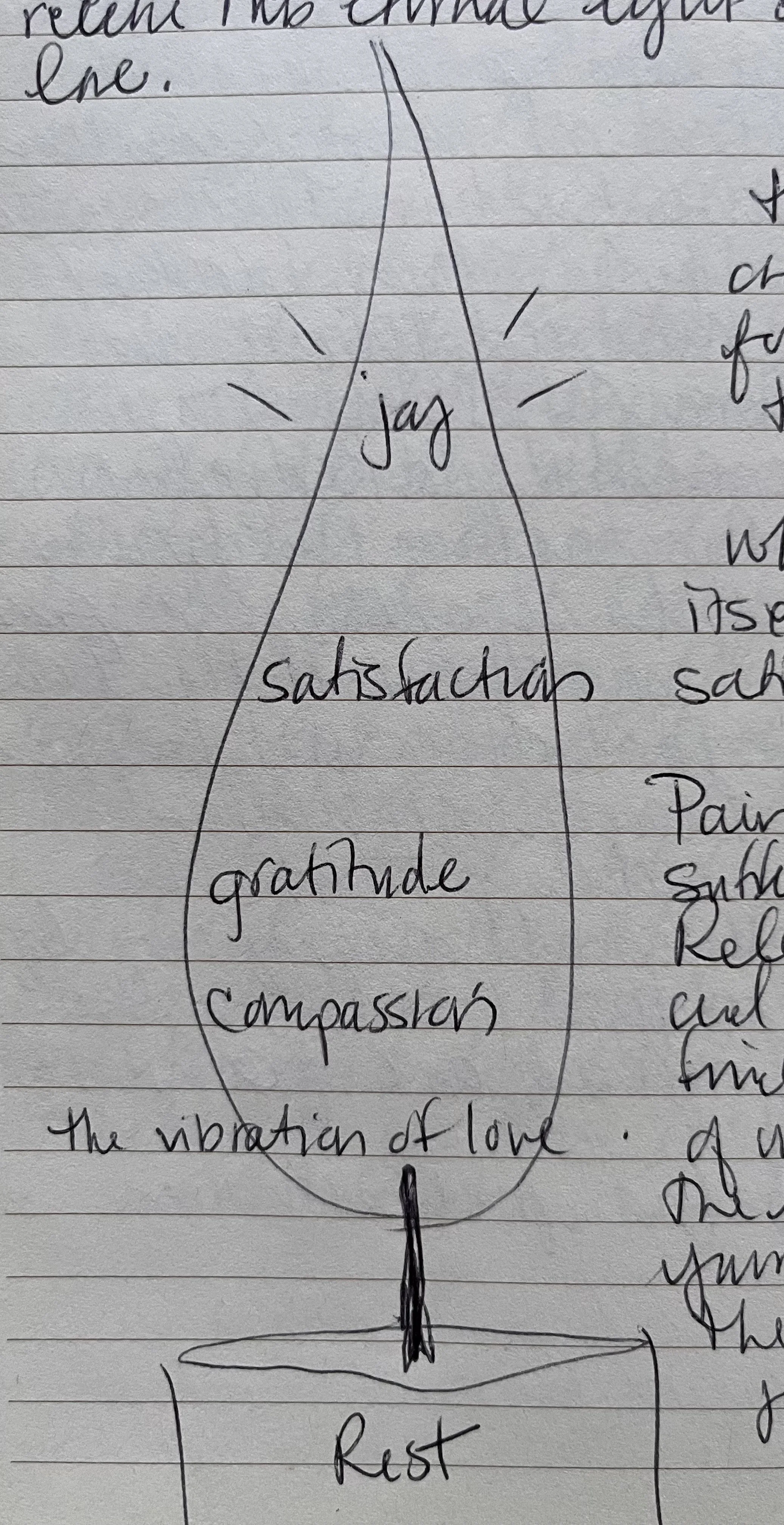
{a diagram of my Inner light}
One of the medium-term effects of a consistent rest practice (that I have observed myself) is the somatic and energetic skill of quickly shifting one’s body-mind-spirit state into a restorative frequency, this shift becoming more and more efficient with practice. Which means being able to access deep, nourishing, rest, during a 5 minute break between calls, or while you’re waiting for your coffee to brew, or sequestered in a public restroom for a couple minutes during a stressful day.
Or taking three deep, meaningful, grounding breaths when you need to find the wave of compassion within yourself, in the midst of feeling angry and judgmental. It also brings more awareness into the sleeping states, allowing us to carry back more wisdom from our dreaming travels. And allowing the body to sleep even when our minds are active.
Well, there’s more of course.
Especially the parts that mean more to discover yourself, and hold close to your heart in a way only you know how:
Offer yourself rest
You deserve to rest
Offer yourself rest
and ask for nothing in return
Your rest will form a foundation
You can build a foundation of consistent, luminous, nourishing rest each day
Let go of doing
Let go of striving
Return to your true nature
Rest is a Portal
There’s no aspect of a cycle that doesn’t require a time of apparent dormancy. And yet that dormancy is often an illusion; it’s no so much that there is no movement or change as it is an unseen process. Eurocentric or “western” culture doesn’t value the unseen process very highly. The capitalistic culture doesn’t even believe in the value of that which cannot be measured. When we want to notice the process inside, the subtleness of our “going on being,” we often begin by closing our eyes. And when we do that we shift our focus away from moving our bodies physically in space and seeing in the external sense.
Resting creates the necessary slowing down to create deeper shifts from a safe location. And frankly we don’t always exit a portal feeling great. Sometimes rest only highlights what needs to change, or ways that we need more of something.
What can appear inactive to others might be full of life and growth internally, and conversely what may appear active in the eyes of others may feel quite slow to the subject. The later is often my experience as we approach the turning of the year. On the outside I feel quite active, I’m often dreaming and planning for the next year, taking stock or what has changed already and what needs to change. Reflecting and integrating, putting out new offerings and calling in greater connection. But internally I am slow. Witnessing without changing (yet), surveying the landscape and settling into unknown and void spaces, asking questions and not finding as many answers.
It has been a delight for me to see so many people en mass start to seriously challenge whether to seek all their satisfaction from work. To consider that maybe there’s something more, that while in practice we may be in harm reduction mode in our relationship with money we can still dream of a life more full and connected.
In the era of “if millennials would just stop buying avocado toast they could own a house” it was surprising for me to discover this past summer how much lacking enough time translates directly to spending money and overall attachment to material things. And how that actually manifests across income (understanding of course that when in more dire straits our choices become more limited). This isn’t about blaming yourself for financial difficulty and fatigue, it’s about acknowledging that there is a vicious cycle between need, want, and urgency. Time is of great value, time is related to rest, and when we don’t have enough time we seek quick solutions to feeling connected and cared for. There were some beautiful and synchronistically aligned thought pieces this year that clearly show this is not just a personal shift but a collective one. But it actually took a while of having enough time for some of my own habits to change.
This summer I enacted a radical seasonal change that I had tried unsuccessfully to implement for three years in a row. The dream was simple: I wanted to make it to a city beach at least once a week for the entire summer and swim in the ocean for at least 30 minutes without having to get up before 8am (I work late folks, don’t judge me!). The thing about natural environments is that they run on their own schedule. Not every day is suitable for swimming in the ocean comfortably, and so you need to have multiple days available. It’s also not a 24 hour thing (for me at least), there’s a limited window of time in the day to be at the beach. Then there’s the matter of rinsing off and getting dry again, eating something, and getting dressed for work on weekdays. The main factor here was that there needed to be a chunk of time available that could accommodate all of that, plus getting there and back. As folks naturally flowed through my practice I had to start taking away available hours a couple months in advance so that I started later every day to make this possible. On the surface this would appear to be a poor financial choice, cutting 4-5 appointments each week for several months. But something totally unexpected happened: the net change was almost (not quite) zero. How could this be possible?? The answer was pretty simple, I was grounded and happy and felt connected…and I didn’t really crave the things I used to. I didn’t mind throwing together inexpensive meals because I had plenty of time. I felt fit, my skin was clear and healthy, and I didn’t care so much about new clothes and such. I was tired from a full morning most days and my “entertainment” was largely being outside. My spending dropped almost inexplicably, and I realized just how much I used money to solve the problem of “satisfaction.”
This may not be a relatable example for you but there’s a version of it that is. One where we try to buy time when we really need space to rest. I’m sure for each of you there is something that you love that doesn’t really cost anything but time… A practice that bends time for you, offers you more in return than it actually took. This feels even clearer as I’ve become only slightly busier and I feel the presence of the old habits creep in. I’ve found that I need a lot more time than I think I “should” to actually rest. And to get that time I need to unplug even more from capitalism, because that’s the math. This also means redefining what success looks like to center the experience rather than how an observable measurement. Assessing value and currency beyond cash: time, relationships, physical health, contentment, connection, and the ability to make choices.
Maybe you’re feeling it too.
Here are some prompts for further exploration:
Are there certain times of year where you feel called to rest?
What does rest look and feel like for you?
What changes in your life when you are truly rested?
What fills your cup?
How does your work life correspond with your rest/personal life?
What are the areas of value in your life, how would you define success beyond metrics of career, money, or prestige?
What are your personal indicators that you are off balance?
What could you change this week to show yourself that you’re committed to restoring your sense of balance?