Select ESSAYS from the Archives
Below are a series of essays, which are field notes from explorations in trance, energy, dreaming, healing, and imagining new futures. They are fro my longstanding newsletter, which fro which Spaces Between and Inward Vision emerged.
Balancing Solar and Lunar energies
A version of this essay was originally published in June 2024, and has been edited and expanded.
Next Friday 6/21 is the Summer Solstice in the northern hemisphere, the longest day of the year. For those living some distance from the equator, this is the maximum potency of solar energy. One may associate it energetically with the Full Moon, the peak of a cycle. And yet, what we often see is that the trees, our gardens, and the animal life around us is just getting started. It finally feels like summer, and the harvest we associate with summer’s peak will not come for another 1-2 months. This is an important detail for understanding the effect of this energy: the metaphorical harvest is a release, that occurs after this fullness. The energy builds and can feel as if it is bursting from every pore, but the effects may not be known for some time.
Seeds take time to grow, feelings take time to unfold, and wisdom sometimes blooms in the dark.
I personally am not a fan of gender essentialist terminology applied to energy, even though of course those qualities exist. But solar (masculine) and lunar (feminine) capture it quite well and these terms eclipse the limitations of our bodily forms.
Solar energy and Lunar energy
Maybe some of you remember from a certain They Might be Giants song: “the Sun is a mass of incandescent gas, a gigantic nuclear furnace— where hydrogen is fused into helium at temperatures of millions of degrees.” Which is to say, the Sun is primarily elemental Fire, but also Air. In working with solar energy we have the metaphorical representations of the elements: transformation, the mind and its thoughts, lightness and free movement. The sun is a literal source of power— it generates and feeds, it facilitates growth, and it can also burn. We can engage directly, such as feeling the sunlight, or through visualizing the manifestations and effects of solar energy.
The moon is a satellite of our earth, and its beautiful light is created by sunlight reflecting off the moon’s surface. One side of the moon never faces the sun, and the other side casts its glow in ever shifting shapes caused by the shadow of the earth, creating the lunar cycles.
As the light is reflected the moon imbues it with new qualities. The tone shifts from warm to cool, from yellow/orange to gray/blue. The gravity of the moon moves and pulls the water of our earth and the water of our bodies. We may feel emotions heightened, and also guided in the dark. The elemental qualities of Water and Earth provide their own form of transformation: steadiness within movement, emotions revealed and released, continued change over time, and renewal/rebirth.
Far from passive, the moon reminds us that reflections are powerful medicine, sometimes we need them to see what cannot be perceived directly.
The complimentary qualities of solar and lunar can be seen best in their relationship to each other:
🟡 Warm | Cool ⚪️
🟡 Bright | Soft ⚪️
🟡 Generative | Nourishing⚪️
🟡 Rapid cycling | Extended cycling⚪️
🟡 Birth Death | Rebirth⚪️
🟡 Cultivation | Integration⚪️
🟡 The “father” | The “mother”⚪️
🟡 Fire and Air | Water and Earth⚪️
🟡 Vibrant | Luminous⚪️
🟡 Rays | Nectar⚪️
🟡 Arteries | Veins⚪️
🟡 Ingestion | Elimination⚪️
🟡 Right side | Left side⚪️
I could go on! Within these representations, we have all the qualities of (re)calibration available to us. But let me speak to one of them just a little more…
Hemispheres of the body
The physical brain has two hemispheres, right and left, which each control the opposite side of the the body. In general, the right side relates most directly to creativity, emotions, and spacial reasoning, whereas the left relates to logic, math, and language. These qualities seem to be in some opposition with the premise behind practices that engage the breath on one side of the body, but when we consider that it is the opposite side of the brain the initiates it, we begin to see how these seeming polarities are intricately connected. Another way of thinking about it, is that the Lunar aspect relates to communication and reception, and the solar is more generative and creative
Working with sides of the body is a powerful way to move energy and ride the current of lunar and solar qualities. When paired with the breath awareness and sound we can observe surprising shifts.
One way of working with these qualities is moving the breath up the left side of the body on the inhale (lunar) and down the right side of the body on the exhale (solar). Alternate nostril breathing, with the third eye point as the fulcrum for this alternating flow of directional energy, is another approach to the same idea. Mantra can also be added to connect more with the subtlety of the energy. Many Tantric Practices relate diurectly or indirectly to balancing these energies, because it is only when the Ida (left) and Pingala (right) Nadis (energy channels in the subtle body) are in balance that Sushumna (the central channel in the spine) becomes active. And it is when Sushumna is active the true work of meditation begins.
The language of plants, and how to listen
The scientific field of plant communication is fairly contentious. The early research, perhaps best known through The Secret Life of Plants, divided the community firmly into two disparate camps. The word communication is at the heart of the issue, antagonized by the human supremacist perspective that seeks to measure all other life through the lens of comparison with human consciousness. But as our capability to measure and “see” beyond the human senses improves, the gap between the “hippie earth lovers” and the “serious scientists” has become smaller. A recent example, Finding the Mother Tree, synthesized some of the research that demonstrates that plants do share information silently over vast distances through the mycelium network underground. Or dare I say, demonstrates relationships between plants. While it stays in the lane of research, it also weaves a subtle thread of longstanding indigenous knowledge being slowly proven as science.
We know that plants respond to stimuli and produce distress signals, and they even make subtle physical sounds. The question of whether that means that plants feel is another one of rigorous debate, again pointing back to a colonialist perspective deeming that all other-than-human life lack the self-awareness necessary to feel or experience emotion.
I’m sure it comes as no surprise to you, dear reader, that I hold an animist perspective that recognizes consciousness as having many forms, and present in all of the natural world and elements. So I hope you’ll understand that I’m using these terms intentionally to create relationship between something familiar to us and something which is beyond our experience, and that these words do not quite capture the idea. There is no currently defined vocabulary for how a wholly different type of lifeform experiences such phenomena, and so we are left with the incomplete language we have created. I digress.
In spite of all its controversy the field of plant science continues to evolve, and maybe even agrees, that the mycelium network bears similarities to a brain, and allows information to be shared almost instantaneously. Not only that, plants can share nutrients through this same network, distinguishing between “competitors” (other species) and plants of the same species. Yet they also collaborate when beneficial to do so, anticipating and responding to possible threats. It resembles the concept of the “hive mind,” a symbiosis of individual and community— overlapping, intersecting, blurring the edges of what it means to be a “unique organism” among your kin.
Our relationship with plants is deep, psychological, and physical. We breathe their air and vice versa. Our DNA is intertwined, especially those that we cohabitate with, and we are caretakers to each other. We literally could not live without plants.
It is common knowledge among self-described “plant people” that it’s important to talk to your plants. Especially houseplants. Plants like to be appreciated just like anyone, and it’s a good idea to let them know in what ways you’re paying attention to them. It’s easy enough to chat idly with your plants and tell them they’re beautiful. The same can be done while walking through nature, silently or aloud.
But how do we listen to plants? How do we expand the appreciation of these beings to truly connect with them? Why would we seek to be intimate with plants in this way, and commune among them?
When I first began studying mediumship, and the practicing of blending was taught, I was immediately resistant. The idea of blending my energy with an unknown-to-me human spirit seemed… creepy. (My feelings on that have evolved, but I think many people can probably relate!)
I was reading Plant Spirit Healing at that time, and had the idea to add this blending technique to some of the practices from the book. Since I had already been using my Reiki practice to exchange with plants, it seemed like a natural extension. Plants felt safe to me.
The first time I practiced mediumship with a plant spirit was incredibly profound. Being a gifted Clairaudient, I had already felt comfortable “conversing” with plants, translating their messages into words, but this wasn’t verbal at all. As I expanded my energy around me and invited a plant being to step closer and perhaps blend with me, I felt a wave of sensation travel across my body. It was cool, like wind, and I felt my blood as sap while my awareness dropped into the ground. The transmission that occurred was not like any other I had experienced before. Time slowed down, or maybe it expanded… my sense of time wrapped around me as I questioned if I really understood the continuity of my own spirit and the nature of reality.
I spend some weeks sorting through what was arising. Strange phrases and observations surfacing at synchronous times. Finding myself attracted to areas of the park I hadn’t sat with before and having unusual animal encounters. Leaves trembled in the wind and seemed to wink at me. Auras emerged around the tops of trees and I wondered, was it possible to have acid flashbacks 10 years later?
Plants know a lot that we don’t. Trees in particular are incredible wise. For one, they can usually live much longer than us. If you’re lucky to live somewhere that has old growth trees, they might be considerably older than any mammal that’s ever lived. It’s a depth of knowledge that’s hard to fathom, elders of our elders. But they also know what their ancestors knew. And what the neighboring communities knew. This idea of knowing is also one that isn’t quite right— it escapes language, but somehow the body is able to understand it.
Plants in general hold unique attributes, special gifts and talents that can teach us about our own ability to cultivate resources within.
Plants often communicate through metaphor. We may pose questions and see scenes from their experience, which demonstrate themes that enhance our learning. They are not separated from their natural cycles. Their resilience in different environments help us understand that we are always in multiple cycles simultaneously: the personal and the collective. Their understanding of death and rebirth is complex, for when you are connected to an unbroken chain of memory the distinction of physical death can be understood differently.
They are compassionate and selfless in ways that most humans could never truly relate to, giving their lives constantly for the nourishment of other beings— they are the only beings who can create their own food from the elements. The individual parts of plants also hold interesting frequencies that unlock spirals of information. Their specialized anatomy hold contradiction and collaboration, much like our psyches do.
Something fascinating about plant spirit mediumship is that there are often dual layers of communication occurring simultaneously, from the species of a plant and from an individual plant. This idea in itself is a bit hard to grasp, but it can be felt— plants are teachers in non-dualism. When we develop a relationship with the plant world, we are offered a window into a completely different perspective. The complicated questions that arise create an opportunity to better understand our place in the vast web of existence.
In my opinion, once this door is unlocked it remains open. We are forever connected and can “plug ourselves back in” when whenever we choose to be present. As in any relationship, and in my approach to Collaborative Mediumship, it is important to engage in reciprocity by asking if there’s anything they wish for us to do. Usually it’s fairly simple stuff, offerings of water or collecting garbage, but I have also received some truly surprising and unusual ritual requests. Each has been instructive and powerful.
My personal practice has come a long way since Meditating with Plants, and as I prepared the mediumship workshop last month I felt called to develop an offering specifically aimed at our relationship with plants. I was delighted that Anima Mundi offered to host me for this workshop on 1/14, where we will be surrounded by beautiful herbal formulations and an environment that oozes with plant medicine.
This is my first in-person offering in quite a while! I will be bringing my beautiful Tibetan bowls I adopted at Menla, along with other therapeutic instruments to provide live sound accompaniment to the mediumship practice.
We will discuss in-depth some concepts and background for Plant Spirit Communication, plant specific “blending” techniques, and the unique attributes of plant communication and language. We will engage in a communal practice to connect with a plant spirit and will have time at the end to journal and share messages.
(Participants will also have 15% off anything purchased in-store following the workshop).
If this interests you, I really hope you’ll join me!
Lighting the Path in a Hermit year
The first night I was on retreat last June, the power went out. There were generators in the main building but not the others. I sat by the fire talking for a couple hours before making the walk to the other side of the property where I was staying. As I walked down the gravel road away from the dining hall I found myself in the deepest, most impenetrable dark I can ever remember experiencing outdoors. The sky was clouded over and my steps seemed to echo around me. Yes, a flashlight had been recommended on the packing list they sent me but I did not bring one, I only had the torch from my phone. The darkness seemed to absorb this tiny light, and only a small circle in front of my feet was visible. As I continued I started to hear all manner of critters moving through the woods. I remembered that there were bears in these mountains and started walking a little more loudly, moving the light from side to side hoping I wouldn’t surprise one.
The thought entered my mind, “Is this the night I die, mauled by a bear? I guess there could be worse ways to go…”
Time stretched and it seemed like forever before I saw the small sign pointing to my cabin. I carefully walked up the steep path and stepped through the door. I was relieved to finally be inside and navigated the dark room to my bed.
Later that week I told the story and how it reminded me of the iconography of the Hermit. This type of experience is very “on brand” for me lol. And in fact The Hermit is my soul card in archetypal tarot! So when I realized we were headed towards a Hermit year for 2025 I felt strangely excited.
They say there are no good or bad cards, but certainly there are cards that people are not excited to see, and probably the Hermit is one of them. We see a cloaked figure, holding a lantern that only illuminates the space directly ahead, otherwise surrounded by darkness. The term Hermit also has colloquial meaning, suggesting a loner, a recluse, or mayyybe a person who chooses to recede for some spiritual purpose. The use of the term hermit as a person who never leaves the house is an interesting extension of the archetype, whose surroundings are not visible in the dark but the absence of light appears to confine them. Or consider the use of the word in Hermit Crab: its shell is not its own, when it has grown too large for its temporary home it must venture out without cover and find a new one.
There’s a suggestion of loneliness, or at least being alone, that is also unwelcome to many of us. Honestly that was my initial reaction, something like “well great, alone forever!” This is one of the shadows of this archetype— that the Hermit is forced to move through life alone, separated from community, living in the dark, trapped, apart from the beauty of life, and has given up. Much like a possible shadow of Pisces energy (the fish eating itself, or perhaps the Ouroboros), there might be an inclination towards melancholy and wanting what you don’t have. It can be a consuming state of mind.
But these are often responses to what others may project onto the Hermit.
I experience this archetype as one that reveals trust, wisdom, patience, and inner knowing. The Hermit cannot see beyond the next immediate step, but this is enough to step forward. The Hermit understands that some answers must come from within, and doesn’t need outside validation to decide when to move and when to wait. When embodying this archetype we are asked to practice discernment, and do the deep inner work (ok, shadow work) of examining our instinctual reactions to situations that are unfamiliar or frightening. We are tasked with confronting our fears of the unknown, and why the unknown would be seen as negative. Sometimes we are tasked with moving so slowly it seems we are not making any progress at all.
We might say that the light of that lantern is awareness, self-knowledge, keen perception, and intuition. The surrounding darkness is a place where anything is possible, the fecund void. And how much does one’s perception and belief inform what is possible? We may navigate the careful balance between dreaming and fantasizing, between imagining possibility and magical thinking. We may encounter obstacles, some of which we see before tripping over them and others that knock us off our feet.
The Hermit holds their own hand as they navigate, another a part of the medicine. But the Hermit may also be surrounded by support and simply unable to see it. Often in life it is a combination of both.
And here is where that spiral opens up into something surprising: we reconsider what it means to be alone, how we define support and who we need to get it from— we might begin to see our world as one that has many untapped resources if we can trust in what we can’t see (the unseen).
We’ll be exploring some of these themes on Wednesday in our New Year’s workshop, including the relationship between Strength (the archetype for 2024) and this year’s Hermit. We will do some journaling together, explore associations and symbology, and eventually move into a journey to meet a future self who can be a guide, helping to shine a light on the path forward (or hold your hand in the dark).
A reminder that this workshop is recorded for those who cannot attend live, and is downloadable so you can work with it as many times as you like.
I also made this playlist to support the shift into 2025: 🎧 Listen on Spotify
Sometimes with these playlists I like to imagine that someone is singing the lyrics to me, so maybe it is the Hermit who will offer a message to you…
Rest is a Portal {part 2}
Rest is a mindset
Rest is a practice
Rest is an act of devotion
Rest is distinct from leisure
Rest is necessary for the repair of the mind, body, and spirit.
Without rest, we cannot heal.
You can find part 1 here (from 2021)
Rest is a mindset
Rest is a practice
Rest is an act of devotion
Rest is distinct from leisure
Rest is necessary for the repair of the mind, body, and spirit.
Without rest, we cannot heal.
There are many ways to rest.
We can only give from what we have.
Our spirits may be limitless, but our bodies and minds are not.
Rest can be a loaded word. Depending on our personal histories, cultural, and ancestral lineage we may have been denied rest, discouraged from rest, or deemed more or less worthy of rest. As I began writing this, I found myself beginning with a defense of rest. You will find some incredibly wise, compassionate, fierce words about the birthright of rest from luminaries such as Tracee Stanley, Trisha Hersey, Lama Rod Owens, Katherine May, and others, as well as many of the prominent modern and ancient texts exploring meditation practices.
From a physiological perspective it is worth noting that our bodies complete cellular repair mainly during delta states of consciousness, which occurs during sleep and deep relaxation. Our physical bodies, including our brains, require this time of rest to clear away debris, heal our tissues, to digest and integrate vital nutrients, to allow the mind to gently work through conflicts, and to balance the neurochemicals and hormones we need to function optimally.
Rest is necessary. Without it, we are not offering as much as we think. Rest is an inside job, and I invite you to explore what it means for you personally, with all the context and details that are relevant to you.
Let us venture forth without needing to interrogate whether we deserve rest, so that we can explore the resistance to rest that so many of us experience. (And mainly I’ll share my own struggle with rest.)
I am nearing the completion of a 40 day Sadhana, of Yoga Nidra practice. I have been practicing Yoga Nidra, a form of deep relaxation, every day since November 7. More pointedly, I have been integrating the practice of rest into daily life, holding the awareness of those little portals into the void— between breaths, between tasks, between apps and emails…
I’m sheepish to say that I have often mistaken play for rest, that I now realize I have rarely rested. Play seemed like the opposite of work, and therefore the thing I needed to bring balance to my life. Which was true. Play is joyful, expressive, and nourishing. Play is a portal to the “child’s mind,” curious and not so attached to knowing. But playing is still doing. It is generative, active, and sometimes even holding the quality of striving. In play I am the subject, and sometimes also the object. There is a clear sense of “me,” and the many expressions that are possible in the free and expansive space of play.
To rest is to let go of doing. There may be awareness, and awareness of the awareness, but in rest even that fades away. Maybe it yields to a quality of we, but eventually it yields to nothing at all— but also the awareness dissolves into a palpable something that makes clear any questions about meaning.
In the last four weeks I mostly stepped back from any formal writing, from any unnecessary working, from doing much planning beyond what I already had planned. I’m bringing more intention and thoughtfulness to when I am “working” and when I am not, distinguishing between meaningful actions and actions meant to quell a feeling.
Allowing those outward movements to be a natural extension of inner movements, from a steady foundation. But more importantly, to release expectations. To cultivate a practice as a worthwhile venture in and of itself.
I anchored the experience with this affirmation:
I offer myself rest, and ask for nothing in return
I started noticing how I am perhaps working a bit more than I realized in my creative expressions, and I also was aware of what I was “producing” even as I was playing. I realized that when I would finally let go I would often return to thoughts and plans of doing. Somehow doing was a means of existing, but also a need to keep proving myself worthy.
Planning for the future became a helpful tool for not sinking into the past, but it was also interrupting the process of repair that begins when we finally release towards ourselves. I would find myself surrendering to these blissful states of being, and then abruptly yank myself out of them with various thoughts of what I should be doing instead. And that abruptness started to stretch out, becoming slower…it began to hold a pause that offered a choice.
With so much pain, violence, fear, and injustice around us, it is easy to believe that relentless action is the only right path forward. It’s easy to minimize the value of rest, even though this quality nourishes our ability to show up for the the relationships and causes that matter to us. Let’s be nuanced about how we understand our need for rest. Because rest as a practice is not in opposition to being active and engaged in things that matter.
Our actions plants seeds, some of which we will not fully understand until later. Our frame of mind in the present shapes those actions, which shapes our futures. In my view rest is different from detaching, escaping, or “taking a vacation.” While we may be letting go of thought, letting go of aspects of our identity, and letting go of shaping, when we rest we are deeply present with ourselves and every other being. We are watching our experience. We are becoming quiet enough to perceive from the deepest wells within us.
In this deeper space we might feel ourselves as an ocean and time as a current. We might remember that our edges are imaginary. We might traverse a thread that leads us back to ourselves, in other versions, in other timelines,
Maybe in other identities entirely. What is an identity? Beliefs are important, and I believe it is vitally necessary to clarify what your beliefs are, to allow your values to shape your beliefs and vice versa. And these are yet more ideas of who we are. We are the ones experiencing those beliefs, thinking those thoughts, observing those actions. And those observers are also an idea of us.
Or at least that’s some of what vibrates through my presence in the void…
When I return I feel a depth of compassion that couldn’t be cultivated through thinking and feeling alone. There is a quality of feeling an inner light that reflects between us. I can see the anatomy of my own compassion, the frequency of love, and how it burns.
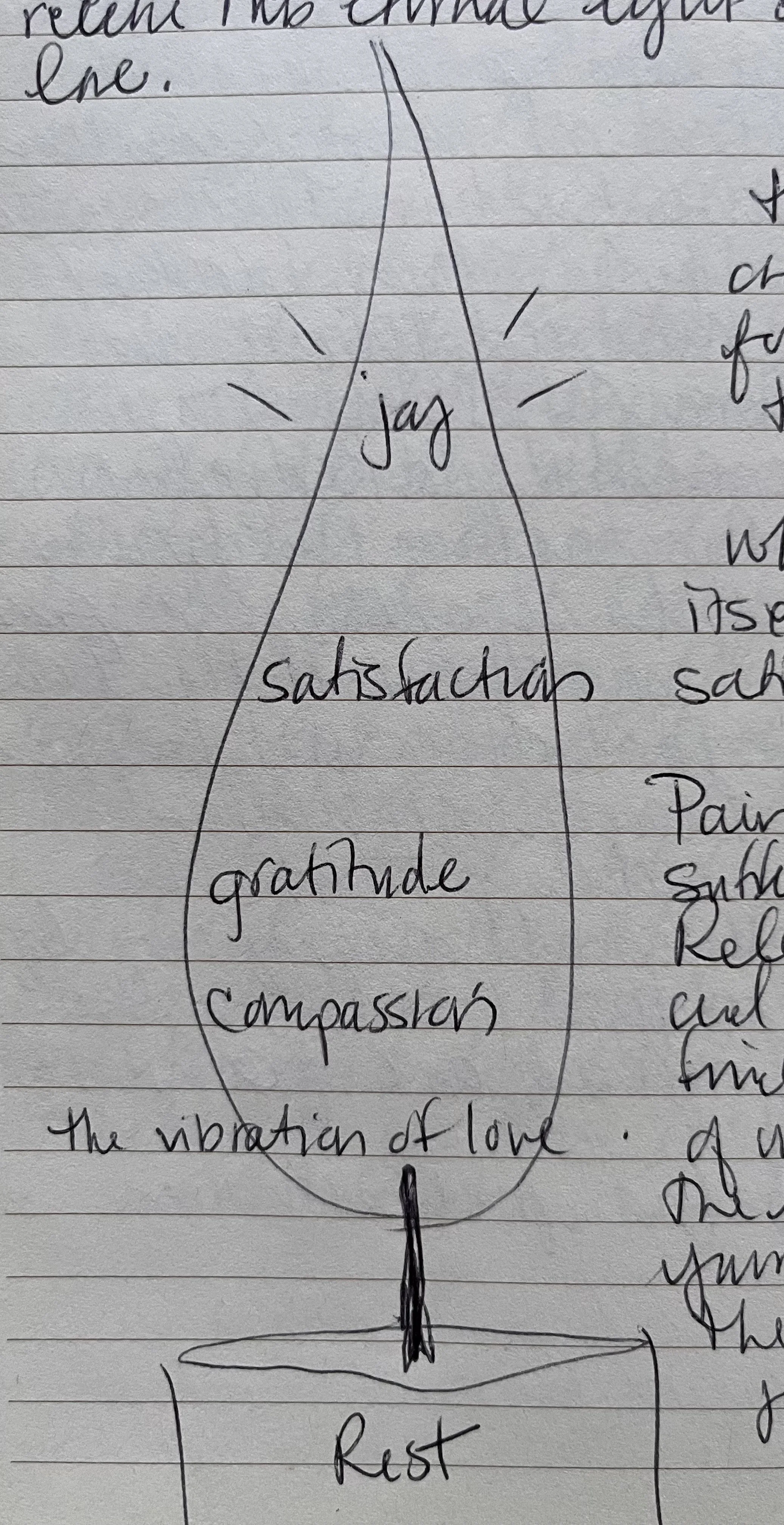
{a diagram of my Inner light}
One of the medium-term effects of a consistent rest practice (that I have observed myself) is the somatic and energetic skill of quickly shifting one’s body-mind-spirit state into a restorative frequency, this shift becoming more and more efficient with practice. Which means being able to access deep, nourishing, rest, during a 5 minute break between calls, or while you’re waiting for your coffee to brew, or sequestered in a public restroom for a couple minutes during a stressful day.
Or taking three deep, meaningful, grounding breaths when you need to find the wave of compassion within yourself, in the midst of feeling angry and judgmental. It also brings more awareness into the sleeping states, allowing us to carry back more wisdom from our dreaming travels. And allowing the body to sleep even when our minds are active.
Well, there’s more of course.
Especially the parts that mean more to discover yourself, and hold close to your heart in a way only you know how:
Offer yourself rest
You deserve to rest
Offer yourself rest
and ask for nothing in return
Your rest will form a foundation
You can build a foundation of consistent, luminous, nourishing rest each day
Let go of doing
Let go of striving
Return to your true nature
The art of Journaling
I suspect every one of you reading has heard the suggestion, or are aware of the practice, of journaling for self-care. It is one of the best, practically free ways to process emotional material and deepen insight. For me it’s right up there with conscious breathing and body awareness as an essential part of any recovery toolkit.
However, journaling is not inherently healing any more than breathing is. There are some well known approaches to journaling and personal writing, such as bullet journals and morning pages, but that’s not what this essay is about (though I like both of those methods).
The following is based on my own practice, and what I have seen work best for my clients. It is flexible so you can tailor it to your own needs. I hope it can inspire you to create your own prompts, and trust that you have the answers you seek.
An introduction: why journal?
When we write out our thoughts, feelings, and observations, we are engaging in multiple levels of processing. We are putting our experience into words, we are reading the words as we write, and we are responding to what we’ve read. Because of this multilayer process, we have a heightened awareness of our tendency to circle back to the beginning of a thought when we reach a dead end or become unsure.
Writing slows us down.
Noticing repetitions invites us to pause, to reflect. And this reflective experience can lead to new insights that we might miss if we were only talking to ourselves (or a friend). We can also observe the body as we are writing.
We can pick up our journal after some time has passed and read back through previous entries. They become a time capsule, a window, and a record from a previous way of feeling and thinking. We remember how it felt then, and we notice how that differs from our experience now.
How do we harness this potential in our personal writing, to deepen our insight and awareness ?
There isn’t a right or wrong way to approach journaling. In my opinion.
However our approach will inform the results, and it useful to consider the benefits of different systems and identify what we intend to gain from the experience.
Reflecting vs Exploring
Are we expanding or narrowing our focus?
Reflecting includes the classic, diary style of journaling. Our writing captures what has happened since the last entry, or whatever is on your mind. This personal narrative can be quite illuminating. It offers focus on a particular frame of time and experience. For some this means it can also skew towards the negative or feel more like venting. For others it can feel banal, a recap without much insight. Reflecting is a beneficial practice for those who struggle with questions like “how I feel about this? or “what do I think about what happened today?” This style of journaling will help you develop a habit of asking yourself, what am I thinking, how am I feeling, how much of this relates to my experiences day to day?
Exploring is more topic-based, such as picking a theme or overall feeling from recent events and examining our experience over time. For example we may identify a theme of feeling anxious in that particular day, and explore its origins, its relationship to past experiences, and how we cope with it. Or perhaps we’re exploring dynamics of a relationship that is causing us discomfort, and we consider what is us and what is them, how do we feel, and how do we feel about what we just wrote, and what lies beyond that? This style of journaling can be expansive, wide-ranging, sprawling writing that keeps pushing deeper.
Exploring is helpful for those who have very active minds and can get caught up in their thinking. The gentle parameters of theme or topic help us to avoid becoming preoccupied with processing the day to day, and push us beyond our initial perceptions.
Do we want a structured or unstructured approach?
A structured approach could include prompts, pulling oracle cards or tarot cards, or keeping a journal for a specific purpose such as after a meditation practice or a dream journal. The benefits are that structure allows us to compare similar experiences over time, seeing connections we might otherwise miss. We can also bring structure by writing every day, and each day creates its own container.
Bringing in even more structure could include journaling alongside whatever you’re reading. Date your entries and use the medium of your current reading as a point to reflect from. What resonates for you and what doesn’t, what does it make you think about? How are you feeling as you engage? Are there any synchronicities between your reading and your daily experience? You could apply the same idea to any creative medium you engage with regularly.
An unstructured approach utilizes free writing, by beginning to write whatever is front of mind and allowing it to meander.
The stream of consciousness process offers the potential to go deeper into the unconscious layers, which are revealed as the conscious content is released onto the page. For those who wish to use writing as a form of connecting to intuition or guides, this style allows for us to stretch beyond what we think we know. Drawbacks to this approach are that such entries can lack context, becoming overly abstract or conceptual, missing the link to the embodied experience of one’s life. One way to remedy this is to implement a theme or boundary as a point of departure for unstructured, free writing.
I suggest keeping at least one structured, and one unstructured journal. I like to maintain a journal that is specifically for “venting” in a personal diary style, because I find that important but I also don’t want my most surface-level reactions to be my whole journal. Often when we are venting it is a time limited experience, just one version of how we feel. Keeping this contained allows us to honor our human nature— We access the benefit of using journaling to process emotions while acknowledging that it may not be a compete record of our experience. A hybrid version of this would be using a weekly planner as a journal, with just a 4-6 lines for each day as an ongoing record, inviting us to reflect on what we wish to highlight (what was really important?). I like to use an astrological planner for this purpose, and this constitutes my daily journal.
I use an unstructured journal for recording my thoughts and experiences after meditation, intentional Oracle/tarot card spreads, rituals, and interactive workshops. I only write in this journal after a practice or when I have something to say. The overall theme of the journal and response to a practice creates a small amount of structure, but I free write until I’m done and allow it to depart from the original topic as needed. These journals may span years before filling up.
I also keep a vigorous note-taking process on my phone where I can put all those random thoughts into their own little space. Sometimes these are the beginnings of essays, and sometimes they are isolated ideas.
What about prompts?
Lots of newsletters (mine included) will offer regular prompts to work with. Subscribing to a few will give you a regular feed to work with.
But you can also create your own!
Prompts are just questions to ask yourself. It is true that isn’t easy to write thoughtful prompts, but it mostly follows the same rules as thoughtful questions:
Prompts that are open ended, allowing for multiple departures into different areas (not yes or no questions)
Prompts that are specific. If you want to explore feelings about friendships, hone in on details of the relationship. Instead of “how do I feel about my friendships,” a more specific prompt might be “when I am feeling insecure or upset, what relationships do I trust to support me and why?”
Prompts that explore multiple layers of a topic or theme. This can include time, such as exploring the past, present, and future thoughts and feelings related to a theme. Or nesting questions that take you deeper into a topic (“what is an area of conflict I’m feeling in my life now, when is the first time I can remember a similar type of feeling, why does this matter to me now, what does this tell me about my needs in this moment?”) Or you can explore different qualities within a situation (“what is something that is calling for release, what is a quality I would benefit from cultivating, what is something I’d rather not experience but I’m still learning something from it”).
Prompts that relate to current events or cyclical experiences. Reflecting on how a time of the year has felt in past years can illuminate patterns in our awareness. Exploring our thoughts and feelings about current events can be a helpful way of returning to the body and understanding why we are responding a particular way. Comparing and contrasting similar experiences, such as breakups or starting new jobs, can also be used to illuminate patterns in our thinking and feeling, helping us to identify common elements and ways to validate our experience.
A few meta prompts about journaling:
What are your early experiences of journaling, including childhood diaries (if you had them)?
Feel into your body right now, in what ways were you aware or not aware of your body before reading this question?
What is the relationship between your mind and thoughts, and your physical sensations? Try toggling between mind and body as your write, reflecting that awareness.
Do you tend to gravitate to more structured or unstructured forms of personal writing?
What do you think you could gain by incorporating more structured approaches to journaling?
What could you gain by incorporating more unstructured approaches?
Is healing possible?
Healing can be a loaded word, and lately it seems trauma has become one too— the subject of numerous think pieces about whether the wider understanding of what constitutes trauma has gone too far. As a person who has experienced both “big T” and “little T” trauma, I feel it’s a great disservice to compare the two. There is some truth to the observation that recently the word trauma has been used more loosely to define anything upsetting or negative. But what effects a person is subjective, and while most people will agree about the negative impact of those big T events, often the more cumulative traumas will be enshrined and buried deep within layers of denial, avoidance, minimizing, excusing, and a lack of self-compassion.
These experiences create deep wounds that are every bit as painful but much harder to see clearly. Such individuals (the little t folks) may maintain a higher level of functioning in the sense of ability to meet basic needs, holding a job, and not physically harming others— but they certainly are not happier. And to define the “minor” difficulties of dissatisfaction and loneliness as matters of personality or a syndrome of some kind, is to see them as manageable but not treatable. It also prioritizes functionality over happiness. The legacy of more attachment-based traumas is often an enduring sense of isolation. That lack of connection can be compounded by the difficulty of describing the experience of their traumas, making it harder still to feel understood by others and to understand themselves.
On the level of collective, societal, and ecological traumas, to suggest they are not “real” traumas is to bow to the cult of individualism— to say that the pain and suffering all around us is not significant or shouldn’t get in the way of being satisfied. Coping with existential pain is difficult enough without having it dismissed or brushed aside as mere “anxiety.” And in a human society plagued by racism, colonialism, religious extremism, ecological collapse, poverty, and communities structures fragmented into smaller disconnected parts— it’s no wonder that so few can say they have been totally unaffected by trauma.
Which leads to a complex question, is healing even possible? What does healing mean?
Any person is entitled to their opinion on as it relates to themselves. I won’t speak for what’s possible for everyone. One’s access to safety matters a lot in this question. Healing (a satisfactory quality of life, with some sense of meaning and connection) requires at least a little stability and safety. Without that we are surviving. Which is also enough sometimes.
In addition to injuring the mind and sometimes the body, I see trauma as a wound to the spirit. The Spirit, or core energy if you prefer, is timeless. If healing is about repairing the connection with our core essence or self, then we have more than this lifetime to do it. Most of the big and overwhelming problems of our societal, human world seem more manageable at this multi-generation timescale and I find it helpful to apply to personal healing too. Our bodies can break, and experience catastrophic damage, and our minds too, but the spirit— our energy— endures. Our spirit is always there, but we can become profoundly disconnected from it. Like a cell phone that loses signal, or walking away from the sound of music playing until you can’t hear it anymore. We can feel as if we have become empty or lost.
A lot of what are considered the “symptoms” of trauma could be summarized as a series of patterned responses and behaviors. Much like the expansion of timescale described before, trauma responses seem much more workable when we view them as patterns. What we consider to be our personalities, are also largely comprised of patterns and behaviors. Which makes them more flexible, changeable, if that’s what we want.
We can also see them as expressions of our energy, in the form of potential energy and kinetic energy. Our task is not to fix the energy but to find new channels of movement and expression.
Connecting to a core sense of self opens the door to this possibility, and the flexibility needed to contemplate what healing can mean. It creates a venue for exploring what kind of change is possible, and what kind of change we are seeking. It is a path back to ourselves.
On many occasions I have been asked by clients and supervisees for good recommendations to trauma workbooks. There are many out there— especially if you’re looking for support that focuses on better managing or dampening the clinically defined “symptoms” of trauma response. But when approached about one that integrates some of the more existential and energy-based perspectives that are the core of my work I struggled to find something.
It inspired me to create my own. I am excited to announced the availability of Inward Vision: a Trauma Recovery Workbook
This workbook will take you on a journey of self-discovery, with dozens of thoughtful journal prompts, guided exercises, creative explorations, and more. It also captures in writing some of my perspectives in a concise, deliberate flow. It is practical, written in a straightforward style that avoids overuse of clinical terms and jargon. The focus is on recovery that leads to a state of feeling satisfied, to develop the skills needed to thrive.
I hope that its unique perspective will be illuminating regardless of your background (it can be for personal use or as a resource to support work with others).
Out of the Lion’s Gate and into the Fire
Somewhere between July and August my Chariot went off-road. Things that had been moving smoothly, if sometimes slower than I wanted, started to develop snags. Like so many interruptions to flow these snags were entirely within my own mind and energy, not the sort to simply force through. Synchronicities were loudly asking for my attention but they took some time to understand.
Creating and sharing can feel a bit like grieving. There’s a tenderness to expression that only you know about, an awe at the transmission of ideas. Opening small parcels and carefully unwrapping them. Placing them gently on a shelf and admiring them. The shelf becomes more crowded and it’s harder to maintain a pristine surface. When you examine each treasure individually, the beauty and importance is absolute. When you step back and see it all together you ask “what is all this?” You wonder if it really matters.
Sometimes I keep a project secret, and tell myself it’s because the creation is enough, but really I’m afraid it will lose its magic under scrutinizing eyes. My own scrutiny can be the worst.
I was walking and saw a stand of tall stalks with bright yellow flowers, which I thought were sunflowers. I figured as much because they were over 6 feet tall, but it turns out they were Cup Plants. They’re called that because the base of the flower looks a bit like a chalice, especially when they’ve lost their petals. I felt called to make an essence with the flowers and came back the next day. There were bees everywhere (I am very allergic to bees!), and I was worried about taking a bloom that was still in the pollination process because there weren’t very many. When I asked which flower to take I was called to one whose stalk was bent over. I wondered if it was too close to wilting to be suitable for an essence but I heard “it is enough.”
I walked to an open field and knelt down in the grass. I placed the flower in a jar with water, exposing it to the sun. I asked what knowledge and purpose the flower wishes to share through its essence. As Pam Montgomery would say, I asked to enter the daydream of the plant. The energy was palpable and cathartic, expanding upon a message I received earlier that morning. When I stood up I became extremely dizzy and had to sit down again.
I received a message:
Sometimes you have an idea in your mind, and when things turn out differently you feel you have “failed.”
Disappointment creates a gravitational pull, expectations creating endless hoops to navigate, distracting you from this moment.
Ideas of what “should be,” confusing you from the truth that you are already enough. Remember that the difference between ordinary and majestic is sometimes only a state of mind. This moment, is enough.
Do not underestimate the power of your unbridled joy. When you can remember your true essence, this energy finds a channel— to cultivate and seed itself.
Reconnect and unearth the radiance that lives within.Let your joy bloom, trust that you already have this power within you.
Shine and receive.
Cup Plant 7/31/23
I’ve been revising and finishing a workbook for trauma recovery. I wrote the whole thing, 50+ pages, over 3 weeks earlier in the summer. It poured out, it was all going quite smoothly. As I approached the final pages of the first draft, I completely lost the flow. It became excruciating, I could barely look at it. I stepped back for a couple weeks, but time alone didn’t help.
Even though I’ve already done all the practices and all the exercises in the book, something about writing them stirred a deep yearning in me, rereading it stirred me even more. Especially the theme of cultivating unconditional self-love, woven throughout the book. Writing it for someone new to these practices required me to remember “what it was like.” I had to go back, and there was pain in remembering the long road to this moment. And there was also Joy, which was somehow even harder to move through.
A confusing paradox of developing non-ordinary awareness is that while you gain access to a form of loving energy that is indescribably soothing, ultimately you need to come back to the ordinary. Even though it should be a relief and a balm for your weary spirit, it taps into a longing and a grief for your life up until knowing the feeling. Even though you finally understand that you never were and won’t ever be alone, you might feel like you’re returning from a distant planet and you can’t begin to describe what happened to another person. You get earnest but confused looks, and that word “lonely” starts to float around.
Cultivating the energy of Joy is also a paradox. On one level it’s simply a choice, like changing a thought. It’s just as natural to the body as fear or sadness, but when so much suffering is around you it feels a bit gauche to say “I Choose Joy.” Joy and Sadness may be opposites but in the energy body they’re not mutually exclusive. Some find joy more natural and they need to build their empathy and awareness muscles, and tune into others more thoughtfully. Others have highly developed “feel the pain of others and minimize their own” muscles and need to actively practice Joy.
From time to time the circumstances of one’s environment conspires to teach you a lesson in joy and you bottle it up for safe keeping.
Splashing in the waves with a dear friend, exhilarated and completely immersed in the magic of childlike curiosity. A shared glance after getting smashed by a wave says “Did you SEE that??” without a single word.
Watching a turtle lay eggs and bury them in the ground, a shocking spectacle that was mildly disgusting and incredibly beautiful.
An osprey catching a fish that was twice its size, dragging it onto the beach and refusing to leave it behind.
I don’t know what happened to the osprey and the fish because eventually I felt I was intruding and walked away.
What is the line between agony and ecstasy? Why are the two so often intertwined? Creation holds them both but we like to ignore the parts that turn our stomach. Cultivating joy is a messy business, because it always holds the opposite. When you find it, the mind sometimes drifts towards the grief that this joy will eventually fade. Staying in the moment can feel too hard to bear and we push it away, or we grip it so tightly that we crush it.
How do you cultivate something while also letting it breathe?
The metaphorical phoenix lets itself burn completely, into ash, before rising again. I don’t imagine it knows for certain this will happen. Does it simply trust it will be formed anew? Does it yield to its own death?
It’s hard to let go of something without a promise of what comes next. In a garden of dreams there comes a time to break down what is no longer alive so there’s room for something else. Destroying something of your own creation seems unnatural. But who better to acknowledge when your creation has died, when one way of being has come to an end and a new one must take form?
Joy celebrates life, including its eventual “end” or whatever becomes of us and some of our dreams. There’s an ordinary sadness to this that feels like an old friend to Joy.
Joy can be a portal, that opens one door and closes another.
A catalyst to finding the flow again.
The blooming of new dreams.
What doors are opening in your psyche now?
What doors are closing?
What dreams and hopes need to find new life, or death?
Where can you choose joy and restore a sense of balance?
Where can you choose to grieve and connect more deeply to those around you?
What does trusting yourself mean for you at this moment?
Timeline Hopping {Part 2}
In late spring I found myself shifting towards exploring more about general topics, after a long stretch of more personal writing. If I’m being honest I guess I started wondering if it was interesting or if people want/benefit from hearing dispatches from my various astral travels. Or maybe as I started struggling out of this particular chrysalis it felt uncomfortable to do so in public.
I’m an advocate of approaching one’s spiritual practice and “manifestation” with a gentle hand, being open to the possibility that your best plans and biggest dreams for yourself are somewhat limited. I trust the energies and guides that I work with to see the bigger picture. But it’s not easy.
It’s been a strange year. Extreme highs and lows. There has been unusual slowing in certain areas and quickening in others. My writing practice has expanded rapidly (a fraction of the writing makes it here). My experience of mediumship has evolved in a way that has prioritized itself, and creating the work (writing it, or recording it, or saying it aloud to myself) has taken a certain primacy over having space to share it. And sometimes sharing it becomes necessary even if it’s not being experienced. (Recordings abound)
Prior to taking a much needed summer vacation back in July, I began having a series of interesting moments of spontaneously shifting into an altered state of consciousness. I was laying out to dry off a bit after swimming at Brighton Beach. It was overcast, and I had been resting with my eyes closed appreciating the more muted, gentle quality of light. I opened my eyes and extended one arm to block the sun with my hand, and looked at the sky. The colors seemed exceptionally vivid and I was surprised to see clearly the curvature of the atmosphere, a bubble of gases surrounding the earth, with all of us and the weather encapsulated within it. Elemental air swirling around, having no where to go it continues to spiral across and around the globe– playing with the water, earth, and sun as it travels. I saw my own mind as this undulating capsule of thoughts and experiences. With no where to go they continue to cycle, finding new ways to manifest and transform again and again. How does one’s mind hold the heaviness and emotion of water, without it becoming stifling ? How do you hold the immensity of your emotional and mental realms without letting them become their own reality?
Just a couple days later I was back there playing in the water. I was floating on my stomach, watching the waves. I usually face the open ocean but I faced the shore. I tuned into the feeling of my feet and the subtle movement. My toes perceiving tiny details of sensation announcing the waves, until I wasn’t surprised by their arrival. They passed through me as my body traveled over them. I watched each sheet of water surge past my neck and charge towards the shore— opening into the awareness of holding on.
I heard:
“It is your (human) nature to look for points in time. To search for distinction. The cycle is always turning but you want to see beginnings and endings. We understand that this is your nature to see things this way. And you must understand that it is our nature to understand that each moments stands alone and together. One moment, after another, after another, forever. The moment doesn’t last, it immediately yields to the next. To the unknown. You can’t hold it, or speed it up, or slow it down. Like these waves each moment comes and passes.”
A challenge of contemplating free will and timelines is that we cannot control anything and yet we can always make choices. We CAN choose certain actions, certain thoughts, to cultivate certain energies, even if all our available choices are undesirable. And yet we cannot control what happens after. We also cannot see the future. Or we can, but the future is always changing so what we see is really just a possibility (a dream?). Our minds can’t fathom the range of possibilities. It would be as if someone handed you a map of a city from 500 years in the future and you said “oh great, I’ll use this.”
Maybe I’m trying to say that the map is this moment. Or to know that dreams and fears are mainly ideas, ones we can pursue while also knowing that the future is constantly being written and rewritten. The feeling and intuition of this moment is a more accurate compass. Whereas your mind is an atlas on unlabeled maps from the past and future.
The next night I was working with dual frequency and my Flowering Mugwort flower essence.
Did I forget to mention I opened up a bottle for myself on the Full moon in Capricorn? This isn’t a shameless plug I but I have to give credit to Mugwort which has a great capacity to reveal the truth within our dreams, to distinguish the dream from the “reality.” But back to the story.
I found myself in a curious state of losing my thoughts. I don’t know how else to describe it. I was working with my Crown and my mind was empty. There was a sort of abstract awareness of myself and how I was feeling without any language. I could barely even hold the observation of not having thoughts. I felt the environment of my body in a way that surprised me. Who am I without my thoughts? What is a dream without language? I fell into a deep sleep and woke myself up early to leave for my trip.
In the incredible relief of feeling my mind slowing down I realized I was in desperate need of this time off. It was both peaceful and a bit dramatic on the level of natural encounters. Perhaps I had been too distracted, or preoccupied with my own emotions, to see that this was a continuation from the whole spring. In recent months I kept encountering dead animals in Prospect Park. Over and over. I tried to say to myself “this is nature too” but maybe it felt too grim so I pushed just out of my mind’s sight. I’ve had a painful and inescapable awareness of how much we (humans) are pushing against the resilience of the “nature” beyond ourselves. All resilience has a limit at which point injury occurs.
I try to meet the natural world and elements with with acknowledgement that it’s not all for my “benefit” or “appreciation,” and that it’s impolite in this exchange to judge such encounters as positive or negative. So I still enjoyed my Maritime Forest hike being chased by horseflies, and spiders crawling all over me the moment I left for a two hour kayak excursion (I witnessed my own cruel nature as I reached my limit of spiders on my face and tossed a couple overboard), and finally on the last day being stung by a jellyfish in the ocean. None were ultimately catastrophic or an emergency but it certainly got my attention.
It can also be like this. With competing needs, desires, lack of space— an exchange, or even sacrifice, is often unavoidable.
You probably can guess already that I don’t really believe in coincidence. Though I don’t think all synchronicities are of deep and life changing importance.
There can be a rawness, a cruelty, an excruciating quality to natural cycles. It’s easy to spin these into a web of “why me?” I have been known to do this at times. I was surprised when I was channeling a meditation on flowers that it was primarily a meditation on death (I should not have been surprised). And I continue to be surprised at how those times when we are “void of course,” experiencing ego death, grieving, or releasing it Just. Keeps. Happening.
I like to say, healing has many endings and many beginnings. More turns around the wheel with moments of levity and catharsis that deserve reverence because they are hard earned. Reiki is said to be a gentle energy but in my experience Your Mileage May Vary.
Energetic recalibration can be somewhat beyond merely “uncomfortable.” Even the adage I often say aloud that we practice reiki for “the highest and best good of all” is really an idea that can’t be realized fully. There is no “good of all,” or if there is surely we don’t all agree on what that looks like. In Karma Yoga there is often a distinction made between what is “good” and what is “good for you.” Or even what is “good” in the grand scheme vs this lifetime. One’s destiny has many paths. Destiny is not set in stone. Maybe there is no destination. There is no “right” path, though there may be others best avoided. Or at least that’s what I think.
When I consider the timelines of my own life, or maybe in general, I sometimes imagine it from a vantage point where they appear like strings of a guitar, or spokes on a wheel— branching off in new directions from a central point that is the beginning of one’s story. But just a quick change of orientation and those branching paths become a single line of varying depths. This strange quality of ending up in the same place even as you may try to avoid it makes we wonder about how much control we really have over hopping or shifting between timelines. Sometimes we have the illusion of choice when really all the available paths are going in the same direction. Sometimes we can’t see where a path leads and we end up somewhere unexpected.
Where do you see yourself in you own timelines, or life path right now?
If you could visualize the near future as a topography, what does the terrain look like?
Are there synchronicities or messages in plain sight that you have been noticing, or ignoring?
How do you navigate without a map?
Connecting to your core self, from a time before memory
Over the many years that I’ve facilitated inner child work, I’ve found that most people (at least initially) find it very difficult to connect with their younger selves in a positive way. Often they carry guilt, shame, annoyance, indifference, or even animosity towards their various child selves. This frequently stands in contrast with intellectual work around not blaming themselves for adverse experiences of childhood. They may experience younger parts as naive, foolish, afraid, weak, or insecure; or sometimes it’s more like those parts are “out of control,” impulsive, argumentative, difficult, or unlikeable. When prompted to consider some point in time before those feelings, some time before whatever happened that created these insecurities and self-doubt, some time when they were embodied and present, I would often get the answer “I can’t remember a time like that.”
Our bodies hold memory, for better and for worse. Our unconscious memory is powerful, but it is also somewhat biased. We tend to validate embodied memory that can fit into some sort of cognitive frame, or “remembered” experience. Whereas the knowing that is more unconscious (intuitive) is less valid and suppressed.
You don’t need to have survived childhood trauma to struggle with embodiment. In general we are encouraged from an early age to “use our words” and experience feelings intellectually. We may also struggle with connecting this way due to gender dysphoria, chronic illness and injury, neurodivergence, and other experiences that create tension between the actual experience of the body and how we want to feel/think we should feel.
I often say that we are all born embodied, but we may not be given time to anchor that feeling. Certainly even in utero and infancy we can experience extreme stress, with no “safety” to remember. In accessing our core self we are able to get below the crashing waves, so to speak, and find that center to build new foundations. Embodiment is about something more than the physical body. It’s the experience within the body. Our physical bodies are imperfect, but they are ours to define. They are vessels in which our spirit or core self lives. They sometimes work the way we want them to, and sometimes not, but they are not the essence of us. Our bodies are a physical form in which we exist and interact.
Babies illustrate good examples of this kind of embodiment. They haven’t yet learned “what’s wrong with them.” Generally speaking they seem amazed at the miracle of being embodied. Look at my hands! This is my foot! I am making this incredible sound with my mouth!
They are also highly dependent on others to survive and right off the bat this creates tension in the relationship with the body. I believe that just like how the presence of an attuned caregiver forms the emotional relationship with the self (am I worthy of love, will I be taken care of?), it also forms the relationship with the body (do I have a “good body” that is easy to take care of and love, or a “problem body” that doesn’t work the way it should?).
Spiritually this is a lifelong conflict, to be an energetic being limited to a human body experience. We may travel to far off places in meditation, trance, and energywork, but at some point we have to come back. Sometimes that adjustment when we return is quite uncomfortable.
I find it interesting to consider that we’ve been having those little moments, consciously or not, probably since birth.
Milton Erickson, who developed a person-centered form of hypnosis, conceptualized the core self as a part of several layers of awareness: the content of consciousness, the conscious mind, the subconscious mind, the unconscious mind, and the “deep self.” The first layer is whatever you’re thinking about currently, followed by what you tend to think about and patterns of thought— a limited set of options. The subconscious is where information from your unconscious may become more available to the thinking mind, but also may be ignored. This is the realm of imagination and story, much of our emotional experience, and that more physical sense of embodied awareness. Our unconscious mind holds the totality of experience, from our entire lives, and is too vast and expansive to hold consciously at one time. It is also where we can easily hold contradictions without conflict, access non-verbal memory, and find the non-physical experience of the body. It percolates up through the layers of conscious awareness through effort or through survival need. It can also influence actions without our awareness.
Finally, that deep self which predates consciousness. It is the more fundamental element of who you are, who you have been, and who you can be. Something I find interesting is that in a diagram illustrating this idea (it’s in the book Therapeutic Trances if you’re curious), showing concentric circles, the innermost circle is the conscious content and it expands out towards that deep self. Which is to say we must reach out to find it, whereas the conscious content is what we hold “closest” to us. This conscious content holds ideas of who we think we are, our conscious memories, things that have been told to us that we believe, things we need to do, and the physical manifestations of our unconscious conflicts and desires.
Connecting with your core self or “deep self” is inner child work. Those versions of you before conscious memory, and conscious content, are where you were most intimately connected to the essence of your being. You simply were your deep self, there wasn’t anything else. Trance and hypnosis can be a great tools to connect with these inner parts but it’s not easy to get there. When we move into trance the first things that come into view are the topics floating in so conscious awareness that require some resolution or illumination. If you’ve ever done trancework that was not strictly goal directed (something other than classical hypnosis), you know that once we go into trance we may have certain plans but we can’t predict exactly what’s going to happen.
And to be honest, using deeper trance techniques for the expressed purpose of inner child work is a little risky. It can stir things up in a way that isn’t always therapeutic. Sometimes it happens spontaneously, which is different. I think it’s better to either let it happen naturally or keep things in a more light trance— an exploratory mode. (Not judging here! I just think that our unconscious is wise and it’s more therapeutic to trust it rather than try to “hack” our unconscious)
One of my first moments of seeing Reiki as something that could be deeply healing on an emotional level was working with my own younger selves. From the perspective of energy work, there is continuity in your energy throughout your life, related to your core self. Alongside aspects of energy that are developed and acquired over time. Much like in Erickson’s model, in the human biofield perspective our energetic experience is generated from the midline of the body like rings of a tree. The oldest energetic layers are continually moving to the outer edges of the energy field with the most recent events held in the confines of the physical body. As we expand our awareness out into the edges of our energy fields we can begin to access the pure experience of times before our memory.
Using reiki for self-healing with our inner child(ren) allows for accessing any place in our own timeline, it’s not necessary to “remember” it.
Similarly to how I approach trancework, I find it even more beneficial to allow the energy to work with you and for your core self to “show” you where to work. Reiki has a consciousness of its own, it sees from its own perspective. It can help illuminate the consciousness of our own energy (which is the unconscious!). Just like our unconscious mind, energy can be in more than one place at a time, more that one point in time, even in multiple timelines and lives simultaneously.
It creates space for inviting those past selves, some cast off and fragmented, back into the energetic fold, part of the same tapestry.
Intuition vs Anxiety
Many of us are taught not to value our gut instincts, and even to ignore them. The less privilege you hold societally the more likely that you have been told that you can’t trust how you feel. If you’re offended, that’s because you’re too sensitive. If you feel unsafe, you’re being paranoid (or you actually brought it upon yourself). If you want something more for yourself, you’re being greedy. If you feel undervalued, you’re just not asserting yourself enough. And so on.
There’s another layer that can be self-imposed: in a challenging, dangerous, unfair world sometimes we choose to tamp down our awareness as a way of coping (and surviving). There are situations where this is beneficial. And there are many where it doesn’t serve us well.
As a therapist often working with a variety of forms of anxiety (including post-traumatic stress) I found that many of the techniques for managing “symptoms,” especially those of a more cognitive-behavioral frame, were built on the premise that most anxiety is irrational.
Certainly some anxiety could be described as pretty “loosely related” to the current events at hand, but it always has some kind of underlying meaning. Why that particular anxiety, why now? And furthermore, quite a lot of anxiety is not unreasonable— even though it may be debilitating nonetheless. I like to say that anxiety doesn’t solve problems, actions do. Anxiety tells you that you’re doing something constructive when really you’re in a repetitive cycle that is keeping you held in an emotionally and physically activated state.
Anxiety often points both to actual external threats (or past experiences of threat) along with present moment challenges in self-worth. Without these components, it is merely “worry.” Which is a normal and transient feeling state that resolves as situations resolve.
My approach to working with anxiety has changed over the years. It began with developing insight as to why it’s making you anxious rather than merely worried or concerned, and how to tolerate fear of the unknown rather than attempting to soothe that fear by rationalizing. I see this as a shift from “everything is going to be ok” to “no matter what, I’m going to be ok,” at least eventually. As I began to integrate the body more directly it became important to explore how to tolerate heightened states enough to remain flexible within them.
Anxiety points to things worth witnessing and working with. They can be a map of our tender areas within the psyche and overall worldview. When we have the capacity to stay anchored and able to make choices in a state of activation, that activation is not as disruptive or problematic to our life. With the inclusion of Energywork, I began to see how cultivating a strong connection to intuition became an alternate expression of that heightened awareness that anxiety brings.
Putting it another way: anxiety allows us to attune deeply to certain sources of “threat,” to notice tiny details in a person’s tone of voice, or correlation of events that we see as significant, or even produce physiological responses to certain situations. These are unconscious coping mechanisms to interpret the environment based on our accumulated experiences and our internal narratives. But those raw skills are also the basis of intuition. Careful use of the senses, in order to perceive more than is immediately apparent is a protective skill. Much like how a big part of pain management is tolerating the psychological aspect— learning to reframe pain as a sensation that is not correlated with doom— managing the psychological pain of anxiety and fear allows us to stay grounded in the face of the physiological phenomena.
I mentioned recently that people often feel confused about how to know the difference between anxiety and intuition. There’s no simple way, no flow chart to definitively tell every person how to make that distinction.
But there are a few key points that can help guide you:
The first is that anxiety often has a “charge” that is quite negative or critical in nature, whereas intuition is more neutral (even though we may have a range of responses to that intuition). Intuition itself does not hold the quality of fear the way that anxiety does.
The second is that quite a lot of intuition is simply brushed aside as anxiety because we have learned not to trust it (remember that first paragraph?). So you might ask yourself, if I say this is anxiety and not intuition, who does it benefit? If it doesn’t hurt you or others to follow your gut (intuition), I say take a risk and listen to it. Then see what happens. Your intuition grows when you take it seriously, and teach your body that you will listen. If the sensations are not disruptive and panic inducing, then whether it’s anxiety or intuition it’s just another layer of awareness to explore.
Finally, very frequently intuition is happening alongside anxiety. Sometimes they are in alignment (if this is the case we usually don’t interrogate it), and other times they are in conflict. For example, we may feel anxiety about speaking up when we’re upset, alongside an intuition that we will regret not expressing ourselves. Instead of asking yourself “is this just anxiety” you could ask yourself “is there more information here?” Allow your anxiety and intuition to dialogue with each other.
In reiki training a few weeks back a question emerged about making this distinction because someone was feeling a little wired/“anxious” during practice. I remembered that my early experience of learning about reiki also helped me understand how to feel the difference. The presence of a greater volume of energy flow can produce sensations that are similar to anxiety: a fluttering/heart racing quality, quickened or more shallow breath, changes in feeling of core temperature as well as skin surface temperature changes. Frequently this begins some time before practice or a session begins, those who have highly developed Clairsentience (clear feeling) may notice this especially. But it doesn’t hold the content of anxiety, and as one becomes more accustomed to it the feeling it is recognized as an increased awareness and connection rather than something associated with a problem to be solved.
Intuition and energy practice go hand in hand for me. If you practice only one, you are missing an important component. Intuition brings that awareness to the “unseen,” and energy practice allows us to do something with the awareness. It’s usually a good idea to take physical actions in relation to intuition when it’s possible (such as sending that text, applying for the job, having the tough conversation, or putting your phone away at a certain time), but often the change that is being called for is an internal one. Thoughts, especially, can be quite prone to repetition and hard to shake out of a well-worn pattern. (Anxiety!) Bringing effort and focus to changing the energetic pattern, alongside the discipline of interrupting thought patterns can create deep and lasting change.
I’ve had more than a few experiences just in the last year, focusing on this blended approach where over some months of disciplined action I have seen my emotional responses to a certain situation completely change. And alongside that, the thought pattern completes in new ways. That feeling of abandonment and loneliness reduced to mere annoyance, sudden insights into far-flung connections between past and present that completely take the air out of the recent situation.
The best part being that these shifts are available even if our environments haven’t changed, even if the people connected to these feelings and thoughts haven’t changed. This is the energetic alchemy that opens up when we allow intuition to become a partner to us, and instead of focusing on “getting rid of anxiety” we listen even more deeply and learn to stay present and secure in spite of it. When we see this as a series of opportunities to continuing growing and healing, the sudden onset of anxiety (while unwelcome) feels less like a punishment or affliction, and more like an ordinary experience that offers us choices.
What is your anxiety telling you?
How do you differentiate anxiety via a heightened state of awareness?
How does your intuition offer additional information when you’re feeling anxiety, are there patterns you can notice?
Intuition and Awareness
In a world that largely focuses on productivity and exploitation of labor as the road to success, it is also unsurprising that frequently intuition that relates to other people is something that folks struggle with managing. It can become wrapped up in codependency, sometimes it becomes a way we exploit ourselves for the benefit of others, or we may unintentionally encroach on others’ boundaries. Chief among the reasons for ignoring intuition is that for many the experience is so overwhelming, they simply tune it out completely.
Intuition is a concept increasingly present in the conversation about mental health and wellness. In the most concrete sense, it can be described as listening to your gut, which is especially important for people whose identities have been oppressed and impinged upon and those who have experienced trauma. Maybe you could say that intuition is an antidote to gaslighting, which would probably explain why so many people who have experienced trauma are (in my opinion) highly psychic. But intuition is more than that. It’s about connecting with yourself and beyond yourself.
In a world that largely focuses on productivity and exploitation of labor as the road to success, it is also unsurprising that frequently intuition that relates to other people is something that folks struggle with managing. It can become wrapped up in codependency, sometimes it becomes a way we exploit ourselves for the benefit of others, or we may unintentionally encroach on others’ boundaries. Chief among the reasons for ignoring intuition is that for many the experience is so overwhelming, they simply tune it out completely.
I remember the first time I saw a class for “psychic development” at a wellness space I had been attending for a while. I used to think that the talk of “anyone can develop psychic abilities” was mainly a marketing technique for people to fill up classes. That’s partially true. But it’s also true that the psychic senses are no less real and available to anyone as the other more “physical” senses. They run parallel to each other. One set of senses tunes into the seen, physical, tangible realm; the other tunes in to the unseen realm. There are lots of things we can’t see that we know are there, and awareness of what is unseen is a benefit to health.
Anyone can improve their senses, physical and otherwise, by practicing with them and completing certain exercises. But we also have senses that are more naturally developed. I believe that every person has intuition, and that intuition can be developed more strongly. This can routinely be observed on the personal level, that you can learn to tune into your guides and higher self and receive clear information. I think there’s a bit of talent involved in doing this with others, mostly because you need to know and feel yourself clearly enough to quickly and accurately distinguish self from other. There’s a tendency in our culture to turn everything into a potential lane of work, that every skill should be sold for a profit. So do I think everyone can “be a psychic?” That would be like saying every good guitar player can and should make a living through music. But also…if you really wanted to do it probably if you worked hard enough you could, at least to a degree? My point here is that it doesn’t really matter. Everyone can benefit from developing their abilities personally for the same reason that it’s good to have acute physical senses: it’s useful and beneficial for everyday life. Some will feel called to use these gifts with others, and some will be happy to use them for themselves (which still benefits others indirectly).
As I was imagining how to write this piece, honing in on my own process alongside remembering exercises you can find books, I was struck by the parallels between the physical and intuitive senses. For example my weakest physical sense is eyesight. I have worn glasses since I was 13 and my eyesight can no longer be corrected to 20/20. I’m sure I could improve the overall health of my eyes through exercises (I do some eye yoga now and then) but there’s a limit. I need to use my mind and awareness, and certain tools to fill in the blanks. It’s interesting to reflect on this and also consider that intuitive sight was the most difficult for me to develop. It was similar to what I described above, I needed to use my other senses and a bit of mind-structure to make better sense of it. And I needed a few tools to plug in for it to feel more reliable.
Meanwhile I have a tremendously sensitive sense of hearing (the sound of my dog clicking his nails in the floor at night will wake me from a dead sleep!). And by far my strongest intuitive skill is hearing, it took very little practice for it to be reliable and clear. Even when I am seeing information I often see words and letters in print instead of images! I don’t know if this connection is true for others but I suspect it might be, and maybe that’s informative in how we approach developing different senses.
Just as we would in the physical, I find it best to focus on one sense at a time. Tuning in to one particular sense on a regular basis helps to deepen your level of detail and clarity. That sense will get stronger, and you will become more aware. There are lots of books that offer interesting exercises to do this, and you can also experiment. That question of talent comes into play too. I’m a big fan of not letting a lack of “natural ability” stop you from doing what you want to do. Because we have the capacity to learn! And we can also acknowledge that each person has unique gifts and some can be developed easily and others will take more work (or you could choose not to). Sometimes our insecurities can also create beliefs about our capabilities that aren’t even true.
Awareness is the other branch of developing these senses. It’s one thing to sense clearly, and it’s another thing to create space to be aware. Awareness is the peripheral vision, the hearing what’s behind you, the awareness of the space around your body. Without awareness, we are only looking (seeing, feeling, knowing) for what we think is there, focusing without seeing the big picture. We are searching for confirmation of what we already believe, and excluding other information.
One of the ways I differentiate intuition from just “what you’re thinking” is that often my intuition has very different information. Of course that’s not always true, but when they are in exact alignment I usually don’t feel the need to interrogate it- you just “know.” So often what we think is true is just a tiny piece of the information available about any given situation. Intuition allows us to sense into what lies beyond our thoughts, our ego, the way that past experiences influence how we interpret the present, and distinguish between our emotional reactions and a broader perspective of what’s happening. It helps us discern between intention and result.
Something I read early on in my process of exploring empathy and intuition, is that such abilities are only hazardous when we can’t control them. If our intuition is a radio, we need to be able to tune the station so that it is clear and distinct, we need to be able to adjust the volume, and we need to be able to turn it on and off. As we develop this ability to make more fine adjustments, we do not need to completely turn it off as frequently. Practicing how to focus and unfocus your awareness is one part of it (like listening carefully in conversation while in a crowded room). I think a lot of progress and skill can be found from honing your senses and awareness alone. And for me it expands to a whole other level when we connect with vibrant energies and guides. Connecting to the sources of information outside yourself is really where psychic ability comes in. Your intuition is still you, even if it is your higher self. It is your spirit’s perspective. It tends to be informed by the many experiences of your different lives, even if it does in some ways transcend them.
Connecting with spirit guides, deities and benevolent energies of your cultural or ancestral origins, the unseen realms, vibrant ancestors, elements and earth energies, and/or a power greater than yourself is where our perspective can become more broad and we step out of the personal. Sometimes the rhetoric about connecting with guides can seem individualistic, or solely focused on “your purpose” and getting what you want and need. If you’re accurately perceiving the information, it’s not only about you.
I mean it’s partly about you; you deserve to be happy, to feel loved and supported, and to have a sense of purpose. But true happiness and purpose cannot come at the expense of others. My guides often say that giving is receiving, and receiving is giving. The two are intricately connected, a constant cycle and spiral. The balance shifts and tilts based on the unique circumstances of the present time but one does not truly exist without the other.
Anxiety and depression, as opposed to worry and sadness, tend to be focused on the unique conditions of the self. Intuition can seem related to these feeling states, but it is distinct. Intuition is informative, and can live alongside anxiety. Like when you’re in a situation and something “just doesn’t feel right.” I’m a proponent of listening to both, in many cases there’s no harm is exiting a situation that feels off even if you’re wrong. But intuition helps us discern between anxiety that is about our harmful beliefs and past traumas, and anxiety that is the body’s way of communicating something that is felt but hasn’t materialized in the physical yet.
It surprises me that intuition is not universally a part of trauma therapy. How can one manage trauma responses without tuning into something outside of that experience? How do we know the difference?
It also doesn’t surprise me. There are countless euphemisms for intuition in the therapeutic language that reframe it in a Eurocentric, scientific method. Associations, “wise mind,” dream analysis, the “field” in Gestalt therapy, sublimation, introjection and repression in service of the ego, a moment of clarity or breakthrough…I could go on. I think it does some damage to the therapist to deny the role of intuition in their work, because without that awareness you can’t hold effective boundaries on this level. It does a disservice to clients too because it gives the impression that therapists have access to secret knowledge. It’s a missed opportunity to acknowledge that this skill is available to everyone and it can be learned. It neglects to explore a vital skill of learning how to turn that awareness off when you’re around people who are harmful or are not consenting to this level of attunement.
I’ve been wanting to explore intuition more directly in a class for a while. Although I was already highly intuitive and psychic before taking classes myself, I benefited from the class environment tremendously. It’s easy to become caught up in self-doubt, and it’s refreshing to connect with other people who hold similar interests. I also feel I have a unique take on it from my years of trauma-focused therapy!
This May I will be offering a four week class called Tuning In, and it’s all about cultivating your intuition sense by sense.
Winter Dreaming
All new things begin in the dark. Night dreams hold keys to the void. This is not exactly the same this as the liminal, the space between realms; we access the liminal in the subconscious, the transition in and out of night dreaming, in the alpha and theta states, daydreaming, and creative practice. Not to argue semantics, but it’s a meaningful distinction because we still hold elements of ego (who and what we believe we are) in the liminal space, and in void states we lose that sense. Which is both frightening and where the magic lies.
Dreaming for me is an act of communion, a relationship. I allow my dreams to hold their own space. I try not to analyze my dreams, but to participate in them. To let my dream selves show me what I need to know. I take some time in the morning to transfer to my conscious mind the vital information, trusting that what is meant to be conscious will be, and some ideas cannot be known in this realm. If the earlier winter initiates a process of looking back, feeling waves of memories and bringing them into the present, the second half of winter is perhaps looking towards the journey ahead while still in the void.
All new things begin in the dark. Night dreams hold keys to the void. This is not exactly the same this as the liminal, the space between realms; we access the liminal in the subconscious, the transition in and out of night dreaming, in the alpha and theta states, daydreaming, and creative practice. Not to argue semantics, but it’s a meaningful distinction because we still hold elements of ego (who and what we believe we are) in the liminal space, and in void states we lose that sense. Which is both frightening and where the magic lies.
The deepest seeds of possibility can be found below the surface of what we think we know.
The void is fundamentally unconscious and unformed. It is pure potential and it is completion. The void is not to be understood, but experienced. Some experiences are unconscious for a reason. We can work with them safely there. But we can also hold the feeling as we transition back and allow this to inform our perspective.
Since the summer I have had a practice before bed of plugging my phone in outside of my bedroom, connecting with my guides and running reiki when I get into bed, and giving myself about 10-30 mins before turning out the lights to daydream, receive messages, reflect on the day, and prepare an intention for my nightdreaming. Sometimes I’m very specific, with questions I hope to resolve, but often it’s simply stating if I wish to travel and explore vs acknowledging when I really need rest and would like to be totally unconscious.
I frequently find that I do start falling asleep towards the end and that marks my transition to turning out the lights and drifting off. I make sure to activate a quality of energetic protection so that I can feel secure as I drift. I have found the practice hugely helpful for working actively in lucid dreaming, as well as overall improving my sense of rest (even when I am awake for a long time trying to wind down).
Recently I have decided to mirror this process in the morning. I consciously state my intention to bring my awareness gradually into a conscious state. I open my mind to anything from my nightdreaming, even if I don’t immediately remember what I dreamt. If there is a dream at the front of my mind, sometimes this means reentering the dream while I’m not quite awake. I wonder and spend time with the feeling of it, how this feeling can inform what is floating outside my awareness.
And before getting out of bed I ask my guides what they would like me to know and pull one or a few cards.
Even when I only have a few minutes, this is enough time to anchor into the awareness that my time asleep and drifting through the void is just as important as anything else I do when I’m awake. Sometimes it’s more important.
It’s giving me a new appreciation for the long nights of this season. My dreams have been telling me to pay more attention to how I’m feeling, not to exert my will over my intuitive sense as I move through waking life. They ask me to listen to my gut. And to practice acceptance for the timeline of unfolding events.
The term liminal is defined as a “transitional” space, or an in-between space. In psychology it is usually speaking to life events, and the effects on our psyche. It can feel quite unsettling and disorienting, disrupting our sense of where we are. For example, when you’ve ended one job and accepted another, but haven’t started yet, you may feel in a liminal and unmoored state. One could experience pregnancy as a liminal space, as you are transitioning towards being a parent but it hasn’t happened yet. Or breaking up with a romantic partner and still living together, the tension between a shared life and a life that is separating into two distinct parts. Or even summer vacation when you’re in school, a “break” from the structure that defines most of the year.
To find yourself “in the void” is more murky, challenging the foundation of who we believe we are. Experiencing a post-traumatic event of uncovering repressed memories, and starting to question everything you thought you knew; being blindsided by a breakup and not understanding why; the death of a close loved one that sends your life hurtling in a new and unknown direction; moving through a disaster or other experience where your life is completely uprooted and you have no idea what’s going to happen next… These are examples of void phases. They tend to hold a lot of fear. Even if you’ve been through them many times they are often unwelcome. The archetype of the Tower, or Ten of Swords comes to mind. “Total defeat. The structure of your life (or your mind) reduced to rubble.”
And yet.
In the lack of knowing, we are also paradoxically in the space of pure potential. Feeling like you “don’t know anything” is threatening to our human desire for predictability (read: survival), but again, it is the space where we can transcend beyond what we believe is possible. It’s important to remember that this feeling is hard to access when you’re in it (it’s unconscious), but we must try to cultivate this awareness alongside the patience to accept the unfolding in its own time. We take actions to support ourselves, while also acknowledging that not everything is in our control (ever). A phrase I heard recently that captures the aspirational end of this is “sometimes you feel like things are falling apart, when they’re actually falling into place.”
Some types of loss are easier to accept, others require a willingness to move through deep pain in order to emerge. In many cases part of accepting the reality you’re in is to acknowledge that some experiences are deeply unfair, unjust, undeserved, and unnecessarily cruel. Acceptance doesn’t mean agreeing to or liking our circumstances, it means sitting in the truth of where you are.
Returning to dreams— to analyze the dream is often to insert our conscious and subconscious associations in order to find meaning. The analysis of a certain dream may sound like “I’ve had a conflict with this person where I felt rejected, and in this dream this person appears in a strange new setting. So maybe it represents rejection or past hurts, feeling like I don’t belong.” Whereas staying with the void might be waking up recalling the dream and feeling into a sense of homesickness, or being not quite in the right place, searching for belonging— a sense of knowing it’s not the right place but unsure how to find home again. An urge to trust that you know what home feels like. It’s there, find your way back.
The second is much more nuanced, and holds the totality: maybe there is an element about rejection there but it’s also about knowing that a change is needed, knowing that there is a “right place.”
I can’t help but move into that analysis sometimes, perhaps a muscle memory from so many years of facilitating psychotherapy (not to mention many years of my own therapy). A lot of insight can be gained through analysis and interpretation. But I do think dreams are unique in their unconscious origin, and we sometimes lose their deeper or hidden meanings by comparing them to what we think we know. The example above is a taken from an actual dream I had recently; the surface interpretation would have reenforced what I already knew and felt. I might have just said to myself “wow I guess that is still bothering me.” But in staying with the feeling I was able to start exploring why it was still bothering me, what it meant to me in a broader sense. It tuned me into much deeper yearnings, an awareness of ways that I hold myself back, invest too much energy in spaces that don’t reciprocate, or let stubbornness influence me to try to “make it work” when I actually need to let go. It held the complexity of seeing my part as a way to see that I could change this behavior in the future— Rather than simply sinking into a feeling about something that already happened and was out of my control.
“The conscious mind is very intelligent, but the unconscious is a lot smarter.”
Here’s another example of distinguishing liminal and void space of processing: that first “hot take” of interpretation was generated within about 5 minutes of waking up. Whereas the second took about 3 days of feeling deeply unsettled, confused, simultaneously eyes OPEN to some beautiful gifts in my life I hadn’t been seeing clearly, and also a bit beaten down by looking back at past decisions and seeing my own foolishness.
Pain is a part of the growth in the void, the poison and the cure side by side.
Whether we suffer in the void though, is dependent on whether we struggle to speed it up or take our coats off and settle in.
We can struggle to find the light or learn to see (feel) in the dark.
Dreams themselves are not necessarily painful, nor is the unconscious generally, but dreams can be a window into a depth of our unconscious that is extremely unformed and numinous. My perspective is that it offers a less painful, even safer, way to peer into the void and facilitate some of the deeper growth even as we may not be in a void phase of life. It’s much like trancework, but even more intuitive and unconscious.
What have your dreams been telling you lately?
What is the feeling of them that first moment when you wake up?
How do you like to collaborate with your nightdreams?
When have you been in void spaces in your life?
What are some personal examples of the distinction between an experience that was liminal vs totally unformed?
If you like, try exploring this in your dreams. Ask yourself in the morning what you think it means, and then try to drop into the feeling of it and see what else emerges.
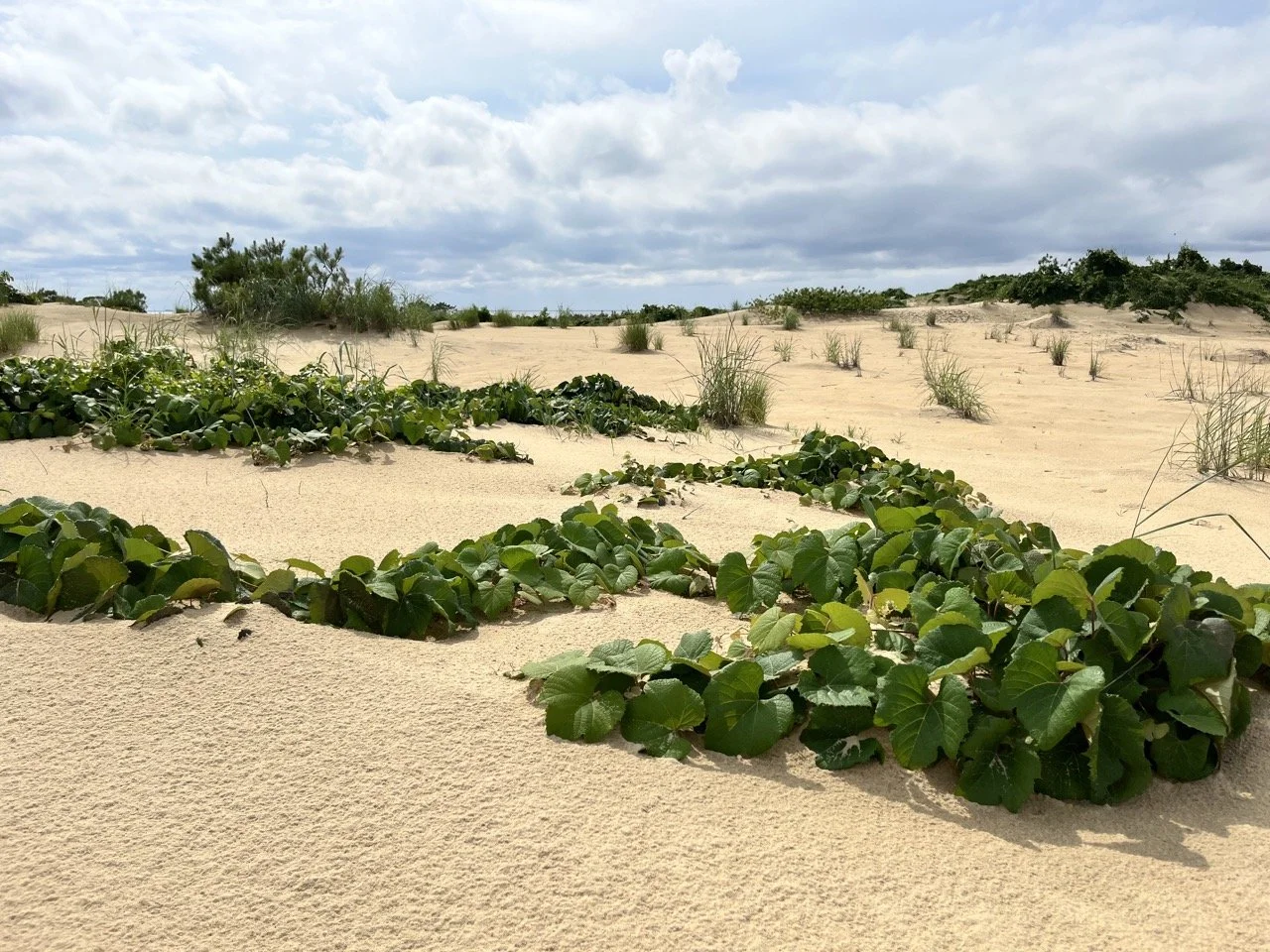
Remembering who you are and discovering who you can be
Seeing the broader patterns of your experience as having echoes in other lifetimes, in other dimensions even, is hugely liberating in terms of allowing trauma to transmute and change. It offers another way to contextualize your experience beyond simply the terrible things you may have endured. It opens up a bigger story.
The first experience I had with past lives was when I was 8 or 9. I had a series of dreams about the time between lives, and glimmers of past lives I had lived. I was fortunate that at this particular time I had a couple of spiritually inclined adults I could talk to about it. So I was not completely alone in contemplating these experiences but there was not much expansion to it after that.
In fact I didn’t have any more dreams of that nature until June of this year.
I had done a couple of past life regressions prior to this, including some more spontaneous experiences in Breathwork. But these dreams were not only glimmers from past lives, they included representation and structure of what that process actually looks like. I believe that had a lot to do with the karmic healing work I began doing in a structured, daily way from March to June of 2022.
This essay was part of a multi-part email series that attempts to capture the experience of exploring past lives and karmic healing. It has been combined and edited for clarity.
As an introduction, this whole piece does assume the premise that there are past lives. I am beginning with the premise that we have a soul, which endures beyond this lifetime and before. Our Karma determines those incarnations, and we can actively work to resolve or complete our karma or participate in life more unconsciously.
There is a perspective regarding karmic contracts and agreements that before we are born our souls choose this particular life, and that this life is uniquely positioned to complete or carry out these karmic agreements, to resolve patterns and complete aspects of growth and expansion that began in other lifetimes. Sometimes this is misconstrued as suggesting that if you experience pain and trauma in this life, that means you “did something bad” in the last or are being punished. This is a simplification and devalues the fact that it is often our most painful experiences that initiate the greatest growth in our lives, while ignoring that sometimes we are simply a part of someone’s story and there’s no special meaning to a negative experience. It is also sometimes said that those souls who have hurt you the most in this life have taken in the greatest karmic debts in order to facilitate those lessons. Again I agree with this to an extent, but not all pain is karmic in nature. And not all karmic agreements are made with love either. A lack of conscious awareness, and therefore choice, is another factor that throws some chaos into the mix.
A meaningful beginning to exploring your own karma is considering the most conflicted, challenging, and impactful experiences and relationships. In this process we can reflect on the connections and repetitions of patterns. At the risk of belaboring the point, not all of patterns and conflicts are karmic in nature but if they are it is likely that they have repeated more than a few times in similar ways. These repetitions could be seen as opportunities to learn something or rework an emotional pattern. If a dynamic or pattern is karmic, this means that it likely holds repetitions in other lifetimes as well.
Seeing the broader patterns of your experience as having echoes in other lifetimes, in other dimensions even, is hugely liberating in terms of allowing trauma to transmute and change. It offers another way to contextualize your experience beyond simply the terrible things you may have endured. It opens up a bigger story.
Before continuing, I want to state this clearly for those who are working with trauma histories specifically, but perhaps it can extend to all. Many of you who know me are aware of the stance I come from, but it bears repeating.
Identifying a karmic pattern relating to abuse, especially with your parents, does NOT mean “you chose to be abused.” This is another avenue to self-blame, it is also a slippery slope to spiritual bypass. Our overall soul consciousness, or core soul, encompasses the big picture of energetic evolution. Even as the soul chooses this life and context, this is based on potentials for healing and resolution. We experience unique qualities of conscious awareness in each lifetime. It’s not all set in stone, with you having agreed to every specific term and event. None of us can know definitively what the future holds because it is always changing. We all have free will, and we make choices based on our conscious perceptions as well. The world around us does not revolve around our individual soul purpose.
The goal isn’t to “get over” being abused, or growing up with neglect and parents with a general disinterest, or not receiving the unconditional love you needed to develop a healthy sense of value as a child. But this a major dilemma of surviving childhood trauma (and sometimes adult trauma): on the one hand you need to find some way to not be defined by that experience and on the other there is no salve that can completely erase old scars— because you’re not the same person now and the echos of that experience need to be integrated. There’s no relationship in your adult life, romantic or platonic that can replace the need for a parent’s love that wasn’t received when you were a child. There’s no degree of trust and connection that can reverse the knowledge that some would seek to hurt a person intentionally, and such people exist and you might not see it coming. There is a lot of heavy shit going on out there and if you’ve been unfortunate enough to witness it firsthand it leaves a mark that one must learn to carry. In this sense, there isn’t a “complete healing” available here.
You could work with these wounds forever and at some point you will plateau because not all healing can revert us to a previous form.
But you also can’t live within that space and expect to thrive. It’s necessary to find a way to move forward and not be haunted by the past.
There’s another spiritual bypass that’s pretty common around this to the tune of letting things go which seems like nicer way of saying “get over it.” It’s not exactly about forgiveness either, although that can happen as a byproduct of healing and realizing that it was never really about you. I would define the healing that is needed and possible as more in the form of transformation, to be sort of reborn in a new cycle that changes the nature of those past harms.
A karmic approach to healing is not a magic wand, or in itself a way to release pain absolutely. But it can be a path towards reconnecting with an unconditional sense of self-love, that includes loving yourself as you moved through your most challenging experiences. Unconditional and ruthless self-love, understanding that every moment of this life, good and bad brought you here, and that you are alive and deserving of joy– this is a resource that can begin to heal the hearts of those past selves. Because this energy can both reach back to the past and endure into the future.
With time, and with love, those present life and karmic wounds can become a book you carry around with you and have read a hundred times, before realizing that you know it by heart. So you finish it and set it on a shelf in your home. It’s there, you can see it, maybe you ever pick it up from time to time and reread an underlined passage. But it lives somewhere just out of your sight line. It’s in the background. A part of your home but not the center of it.
And you also begin to realize this tale has been told many times, in many ways. It’s not your unique burden that was made for you, and it’s just one part of the bigger fabric of your soul’s story. Even when you reflexively pick that story back up, and become engrossed it it, you can remember “oh, this this just a story, I can set this down.”
This creates a new story of your life where you can alchemize your pain into expansion.
I don’t claim to have mastery of this, it is lifelong work for us all. Sometimes, indeed in the writing of this series, I have found myself in a familiar place of feeling totally overcome by grief. Existential pondering can feel very alienating, confusing, overwhelming, and even hopeless at times. What is life even?? These are the moments when we need to invite our unconscious to come forward, to be held by our guides and teachers so that we can hold these ambiguities without short circuiting. Like Dorothy and her ruby slippers, we must remember that we already know how to return home.
Something important to contemplate in understanding “past” lives and what they have to do with us, is that linear time is a human construct and one that doesn’t really exist in the broader cosmos. Past lives as a concept in the daily vernacular generally views lifetimes in a linear way, where there are a series of lifetimes occurring one after another up until this present lifetime, and the future lifetimes haven’t happened yet. When our perspective broadens to time being circular, continuous, simultaneous, moments strung together by our mind, then we can understand that these various lives are occurring in the same timeframe and informing each other. Another way to view it is that perhaps these are other dimensional selves, or perhaps we can imagine an answer explained by “spooky entanglement.” I think these could all be true, and a greater truth is beyond our conscious comprehension.
When we seek to have a glimpse into the differing contexts of these patterns as they played out/are playing out in other lifetimes we can relieve ourselves of some of the angst of why we struggle to change behaviors that are causing us pain. Or why we are attracted to certain kinds of people even though those relationships are ultimately unsatisfying.
…Change is hard. As humans we are pattern makers, and we love to use patterns to predict the future. We’re not very fast, or strong, our eye sight, hearing, and sense of smell isn’t all that great, and we take a very long time to physically develop and be able to care for ourselves. Our ability to identify patterns to attempt to predict what is coming next is not unique among sentient beings, but we are heavily reliant on it. Our bodies hold memory, and our energies hold memory. It’s often pretty unconscious, our bodies responding even before our mind makes the connection with a thought. Changing unconscious patterns that are rooted in our survival (whether our mind agrees this is true or not) is extremely hard. It takes a lot of repetitions. Our energy itself can become bound up in these loops, unable to reach its full capacity for flow.
I’ve spent quite a lot of time pondering what it would be like to be a consciousness without a body, just energy existing or moving…wherever energy might go, and perhaps I get a taste of it when I astral project. It seems pretty cool and interesting to me, but from what I’m hearing as I continue these travels between realms it’s a pretty cool and incredible thing to be embodied. To be anchored and have the capacity to move energy, to transmute it, to shift it consciously and within a 3D physical experience is an amazing skill we have as humans (other beings on earth can also do this of course). I believe that’s why we choose to incarnate. I don’t want to say it’s boring to be without a body, I don’t think that term has relevance in the broader multiverse, but it’s a unique way to cultivate experience (which is to say energy).
One of the dreams I mentioned earlier that I had recently took place in the mundane environment of a hospital waiting room. Someone came out and said “Ok, you’re going to die. So we need to know what you’d like to be done with your remains.” And I go on to say I want to be cremated, but if it’s legal I also think an ocean burial sounds pretty neat… and they interrupt me to say “no I’m talking about your body, what are you plans for your consciousness?” I’ll skip of the more personal elements of this conversation but essentially this individual said that we choose if we’re going to have another life here in earth, and knowing if you plan to come back or move on to another realm is important because it informs how you may choose to resolve your karmic agreements in this lifetime. When we do not make a choice, we are leaving much of this potential resolution to chance.
This of course is a dream, my dream, and not a prophetic declaration I’m making. But I was surprised in that moment that the idea of not returning to earth, for all its bullshit and problems, made me feel overwhelmed with grief. I definitely had an understanding that this notion of reincarnation being a hierarchal one, where we progress in the forward march of time (or don’t) and then “graduate” to the great beyond is not a useful framework, and moreover it’s not accurate.
What a relief actually to be able to say to yourself “yeah, I don’t think this is going to be fully resolved for me in this lifetime but I’m going to do my best to make whatever progress I can and that’s enough.” And in contrast, as rewarding as it might be to have the sense that those resolutions are within your grasp in this life, how sad to imagine leaving planet Earth permanently for the next…I don’t know— dimension? Planet? Space? Unembodied consciousness? Spirit guide?
It’s worth thinking about because it reflects some of our ideas of what our soul purpose is. Why are we here? What matters to you, what do you want to accomplish in this life? And how does this find balance with just enjoying the experience of being alive? Enjoyment and wonder seem like importance parts of cultivating consciousness to me… it can’t all be doom and gloom (contracts and vows! trauma and lessons! This can’t be the whole purpose of being here).
If you’re inclined to believe in spirit guides, this is where we might be able to access some support in bridging the gap between what brought us here and the general experience of our lives thus far. While reading Essential Energy Balancing, the author refers to the Lords of Karma as the sort of governing body of karmic contracts. This concept is echoed in a lot of writing about karmic healing. I did find those meditations very interesting and would highly recommend them, but something about the language and overall description felt in contrast with my experience. Or maybe my feminist sensibilities just gristle at the word “Lords.”
I might prefer to say that within our meditations, and in collaboration with all our guides, teachers, supports, angels, etc. as well as the concept of karma as something that goes beyond just us individually, we can assemble a sort of counsel of advisors to help us tune into our own soul’s memory. And this would unique to each of us.
It’s ironic that perhaps one of the most effective methods for cultivating energy and consciousness is to live a life on earth, but the catch is that the moment you’re born you “forget” pretty much everything that happened before. I feel like there are countless movies and books that essentially explore this awareness in the creative unconscious. Remembering those “past” (really “other”) lives is then an important key to deciphering between becoming distracted in the everyday affairs, drama, and consumption of our lives vs. staying focused on what’s really important to us and benefits the collective. Some distractions offer lessons and opportunities, others are more like “Groundhog Day” where we just repeat the same experiences much as we try to change the outcomes.
The Intersection of Past Lives and Ancestral History
I recently listened to a long and very interesting episode of Ghost of a Podcast, which explores an in-depth sort of case study over three generations, and demonstrated how the natal chart is born of the past, present and the future: it holds much raw data, but it is also not a predictor of the future. It is a screenshot of themes, potentials, resourceful qualities alongside the tricky spots of where we are pulled into dysfunction. Along with the karmic imprints and past life energies we hold, all those incarnations of consciousness we have had, we also hold in our bodies and brains the dna of the ancestors within our family lineage.
Ancestral work is then a part of karmic healing, and sometimes the most tangible way that we can affect it. The choices we make, the patterns we can shift in our current relationships open the door to letting that healing flow back through your lineage as well as forward. When we request or focus our energy towards karmic resolution and integration, we are specifically asking for that energy to move backwards and forwards in time: through all the versions, all levels of energy in our body and aura, all the generations, this lineage and others.
We do so in a respectful way that does not impose this will onto others, it is focused on the effects that we have had and continue to have on others. Energy is not bound by time, and so when we approach karmic healing on the energetic level we can use our experience and awareness in the present moment to feel into the past and future. We can also identify energetic echoes, stagnation, and hotspots felt in the present moment and begin to work with them metaphorically even if we have no idea what the context is. Stagnation happens for a reason, but when we have the ability to allow flow and make the necessary changes to support continued flow, we initiate healing through doing so.
Identifying our unique gifts, that we have inherited through family lineage and past life lineage, points us towards our soul purpose. Clearing the energy that is blocking us from shifting into new patterns, stepping into another spiral or timeline of development, is often necessary to allow us to integrate the lessons of past traumas without feeding the pain of those experiences. Remembering who we were may inform who we are now, but we must also make choices about who we want to be. In addition to clearing discordant energies that are keeping us in the past, we must also tap into frequencies that allow for transmutation and expansion.
Actual transformation requires death and rebirth, release and cultivation, salvaging what can be transmuted and returning to source what no longer serves a positive purpose. Just as trauma healing cannot be accomplished through insight alone, knowing the details of past life experiences and karmic patterns will not automatically resolve them. We must remember how to tune into our own ability to transmute energy, you are the venue of this change: through your mind, body, energy, and actions you create new personal realities all the time.
Journal Prompts for further reflection
What are some of the relationships or patterns that seem to keep materializing in your life?
Do you consider them to be karmic in nature?
Do you have any sense of your “past” life experiences? What were they?
In what ways does time feel open ended to you and in what ways does the past feel like a predictor of the future?
What could change in your life if you could avoid repeating certain karmic patterns in the future?
What are the areas of your life where you feel your energy is being misused, or where no matter what you pour into it nothing seems to change?
What are your own unique abilities that can positively influence those around you? Are you using them?
To what extent do you have a conscious awareness of what your soul purpose is, or what you would like to achieve in this life outside of the material?
How does being a parent, or not, factor into your ideas of Ancestral healing? How much of your purpose feels connected to your family of origin and the difficulties of this life?
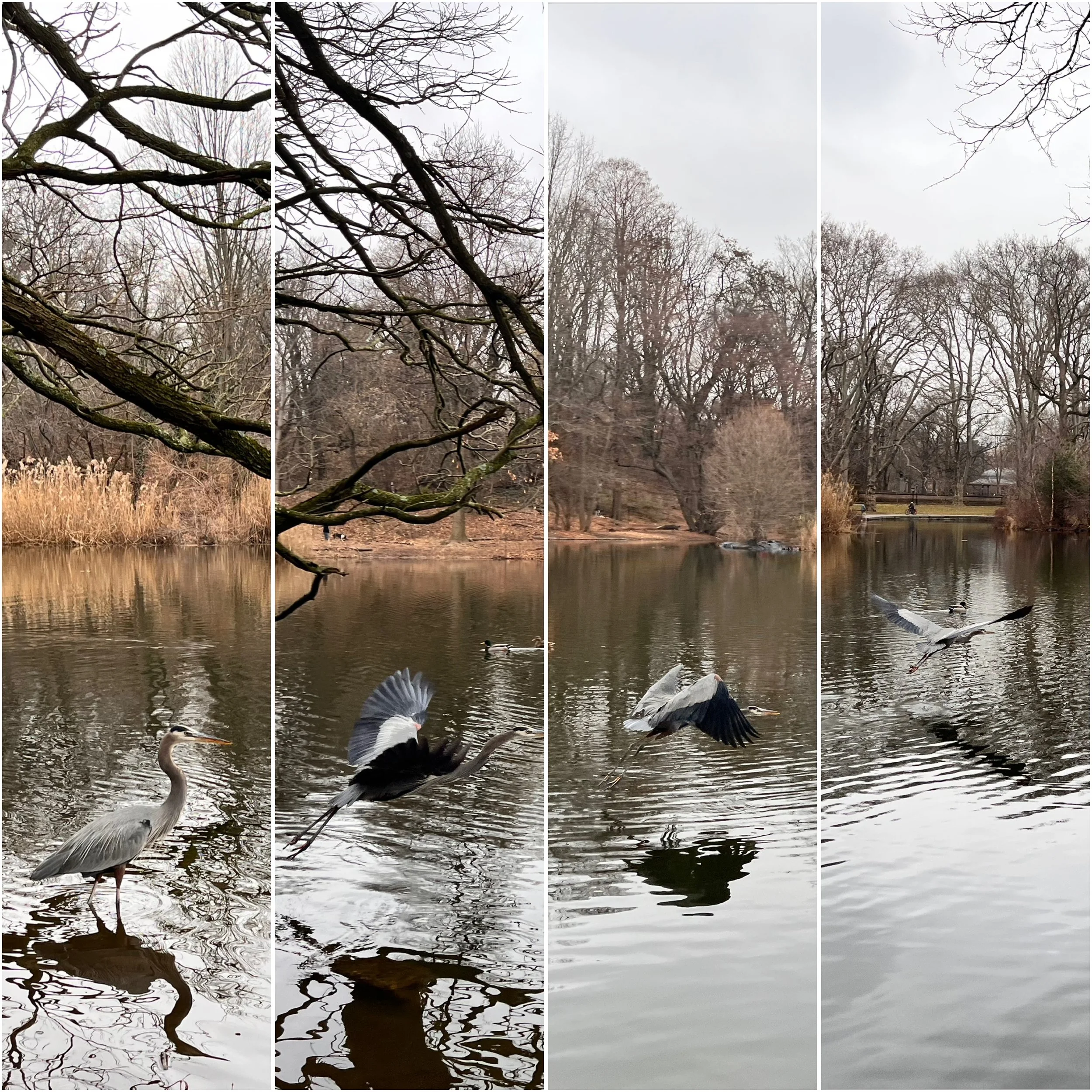
Timeline Hopping
Just as there is no way we can undo the events of the past, our experiences do not actually eliminate parts of our being, only our access to them. The energy kept alive through detachment carries so much power, it draws us in and shines a light on our pain and fears. The tendency to see ourselves as changing in only one ever moving direction fuels this idea that the future is unknown (and sometimes scary) and the past is a time capsule where experiences no longer change.
Working with past and future selves, naturally lends itself to considering the impact of your experiences and choices on how we express ourselves today. Something that emerged in the recent reiki group was this tendency to see a negativity bias when we work with past and future ideas of self. Quite often when we think about influential experiences, we first return to ones we wish has been different. We may think of a traumatic event and wonder who we would’ve been if that hadn’t happened, or we think about a decision that in hindsight we wish we had not made. This can actually be a really healing place to work, because we can confront some of those beliefs about what we lost in ourselves and be curious how to reclaim it (even though we can’t change what happened).
But we can also see that as a manifestation of energy: energy endures.
Just as there is no way we can undo the events of the past, our experiences do not actually eliminate parts of our being, only our access to them. The energy kept alive through detachment carries so much power, it draws us in and shines a light on our pain and fears. The tendency to see ourselves as changing in only one ever moving direction fuels this idea that the future is unknown (and sometimes scary) and the past is a time capsule where experiences no longer change.
In the mechanics of human memory, we know this isn’t true. Every time we access a memory we put our unique spin on it based on our awareness now. Our unconscious, perhaps, holds a more objective perspective but I don’t think that’s constant either. Indeed in Trancework sometimes we discover long forgotten memories, that differ from what we consciously recall about a situation.
After reclaiming a joyous memory of my childhood, playing on a rock formation behind my home at the time, I had the opportunity to drive back through the town as my wife and I were heading back from a trip.
I had not been to this place since I was 12 years old. It was the scene of many night dreams and revisited memories since I left. On the one hand I had a pretty clear recollection of the layout of the town, though my sense of the landscape had become shaped by its appearance in my dreams. I was surprised by how disorienting this was, it was almost like an out of body experience confronting the similarities and differences. My old house had some major renovations since the 90s but the basic structure was the same and below a newly added deck I could see that rock formation from my memory. It’s strange as I’m writing this that the newer experience of actually being there seems much more abstract and dreamlike than the memory from 30 years ago that I revisited in trance.
Seeing it in-person was like visiting an unoccupied historical site, the life drained out of it from reexperiencing a memory mostly untouched since childhood. It was a memory of feeling so free and creative, playing with water pooled in the large craters in the rock, running in the damp wetlands behind the house, the smell of skunk cabbage, the sensation of stirring mud with a stick…it feels incredibly important and vibrant because it is shaped by the meaning I now attribute to it. In “real time” it’s a very cool looking rock that is now covered by a deck.
Rediscovering this memory allowed me to rediscover a part of myself that I had forgotten. Consciously when I think back to that time in my life it’s not a happy recollection, one I’m happy to leave in the past. But as I feel into it I can remember that there was a tremendous sense of joyful rebellion I left that behind as well.
When working with the unconscious, the past and future, it is often true that the poison and the cure are living side by side. We bury that which is painful, without awareness of what else is with it. And similarly we look to the future with anxiety and pressure, “will I make the right choices, what if I do the wrong thing, how can I get to this place that seems so impossible and far away?” and forget that it is also a vast and expansive place of possibility. That there are future versions of ourselves, from other timelines with different experiences that have extremely valuable resources that still live within us.
Our conscious mind shapes so much of what we think is possible, and even though there are limits to our free will (such as all the other people, and systems, and politics, and, and), how we experience ourselves within our own spirit— or consciousness if you prefer— is actually limitless. It is endless, ever changing, always changing.
I recently had an encounter in Mediumship with the spirit of my maternal grandmother. Most of my memories of her from when I was a child were that she didn’t really know how to engage with a young person, and more so that my mom had a very challenged relationship with her. One of my most vibrant memories was actually my grandmother telling me stories of her mother, when they lived in Mexico. She described in such loving detail how my great-grandmother’s long, black hair went down to her waist and and how she loved to feel its smooth texture. I actually have an image of it in my mind from back then (I was maybe 6 or 7) that is still completely alive, imagining my grandmother’s little hand stroking the long braid of hair down her mother’s back. My adult mind, as I reflect on it, is moved by the detail and emotional resonance she had in telling it, the love and longing she still felt for her mother who had died over 20 years prior.
And as she took me on a mind journey, I felt her deep longing for forgiveness, and noticed how in spite of the challenges in her life path, I resemble her in many positive ways: her love of writing and travel, her appreciation for ceramics and fabrics (you should see my collection of blankets!), and a deep spirit of independence. I even look a lot like her when she was my age. I began to see my own memories of her in a new light, the ways that she really did love being a grandmother, even though she did not know how to express that to a child. I felt the intention behind her strange ways she tried to connect with me.
In this new awareness I skipped through timelines as well, to another version of my experience where I wasn’t tending someone else’s ghosts. I could begin to imagine a path in this new version where I could lay down those relics and let them rest. This was not my personal burden to carry.
My grandmother, around age 35
Timeline hopping can be a brief exercise that’s more goal oriented, like resolving an inner conflict, but it can also be expansive and lead by something deeper than what you can remember. When you open the door to seeing yourself in this way, to seeing that you are not fixed in one position— not now, and not in the past or future— you can open up to completely new ways of being.
The more we can release our conscious expectations, or just be willing for them to be wrong, more and more doors of possibility open. We simply need to cultivate the curiosity and openness to another narrative emerging alongside. If this sounds like a spiritual bypass, I can assure you that it’s not because it’s actually very hard work. Those conscious and trauma-based narratives are persistent, powerful, painful, and clever. They really have a way of crashing the party at the worst moments! And I also think over time it becomes easier to practice this way because you learn how to stop fighting your stories and let them be. That’s a version, just like others I’m exploring.
This has been one of the keys to freeing myself of living in what I often refer to as a “trauma vortex,” allowing the stories to exist in the background where it doesn’t interfere with where I want to go. The family mythology can broken down piece by piece, and new stories emerge. I feel excited to think about a future self 5, 10, 20 years from now who could look back at this moment. She says “buckle up, because you’re just getting started!”
Those future selves with a sense of humor are appreciated.
Want to try out some timeline hopping on your own?
You could start with drawing out a lifeline, a dynamic timeline of the most influential or important experiences in your life both positive and negative.
Notice the clusters of events that occur at important ages, notice the entrances and exits of “important” people. Pick a time period to turn your awareness towards.
Maybe you want to connect to that by revisiting some neutral memories from that time, or listening to some music you liked, or even revisiting a physical place you used to go.
Allow yourself to be aware of how events from that era of your life sculpted the current timeline you are in. Common themes might be moves, changes in interest, relationships that began or ended, as well as perhaps working with more difficult memories.
Allow yourself to be curious about how things may have progressed had that important event not happened. Take it forward to the present age.
Who would you be, what would be different and what would maybe be similar still?
Are there elements there you wish to rediscover in you? (they are still in there, the seeds of possibility)
Are there challenging aspects that can be important reminders of certain instincts or proclivities that live within you? (with awareness, we are more able to make choices)
Maybe you can even imagine dialoguing with the future self, inviting them into your life to collaborate as you work through a challenge you’re experiencing now.
Maybe you could draw a picture or imagine a collection of selves, sitting around a table sharing stories about you from the past and future.
Maybe you want to tell the story of your current timeline and see what they have to say…

Dissociation and our personal cycles
How can grief, rage, trauma, hopelessness move and invite other experiences alongside it, without some active intention to bring in something else? Sometimes suffering can feel like a badge of awareness, where cultivating joy becomes an affront to others. As a commentary culture we seem increasing out of balance. On the other side is the spiritual bypassing and avoidance that also promotes disconnection, trying to eliminate or suppress rage in favor of more “healthy” emotions.
I recently read a Pitchfork article about dissociation and music, that was a surprisingly nuanced and interesting take on dissociation in the cultural zeitgeist in general and songwriting more specifically. It tied together and stimulated some thoughts I’ve been mulling over about this particular cultural moment, and the influence of social media and the 24 hour news cycle creating pressure to make a constant running commentary about the horrors that are ongoing as well as consuming that commentary relentlessly. Increasingly the automatic and repetitive nature of how sometimes respond to these continued crises has me thinking that this too is a form of dissociation, except that often we’re still talking. As has happened the last three essays I’ve written, new and completely enraging news emerged while I was still in process. I found myself reflecting on the ways that we succeed and fail to pull ourselves out of dissociative loops. (And while I am feeling quite a lot and have a much to say about it all, I’m going to take my own point and leave that to the more relational dialogues that are possible in conversation rather than broadcasting my feelings here.)
In the last Reiki 2 training I facilitated we had a discussion about dissociation vs trance. It can look sort of similar on the surface, but it’s completely different. Or maybe another way of putting it is that some trances are therapeutic and others are not. The key for me is that therapeutic trance is deeply embodied, so much so that your body becomes your primary environment. You are so connected to yourself and the collective that your physical environment is no longer primary. Whereas dissociative trance is disembodied, out of body, detached, and disconnected. To be in a therapeutic trance, whether it’s light or deep, brings a connection to oneness and there is no past, no present, and no future. It allows us to honor our strengths and limitations, and find balance.
I would venture to say that doom scrolling and obsessive news consumption is a form of dissociative trance (and a reexperiencing and hypervigilance response too). I myself am a daily reader of the news, but I have to often check in with myself and ask “am I learning something new or am I just experiencing the same disturbance and obsessing? Is learning more about this a meaningful action? What is a meaningful action? What am I feeling right now?” Exposing yourself to content can be a form of connecting to feelings and processing them, but it can also be a freeze state that contains the illusion of movement, where we feel there is virtue in immersing ourselves in a certain feeling in the absence of knowing what else to do about it. Sometimes meaningful action doesn’t feel like nearly enough and we must hold those complicated feelings in a state of “unresolve” for a period of time, resisting the urge to busy ourselves as a form of numbing.
This dynamic is present in the spiritual and psychological community as well. The somatic version is dropping into grief/sadness/rage intentionally without any follow up regarding connection and resourcing. What exactly is the value of doing that if there’s no recalibration and capacity to find deeper connection and support? How can grief, rage, trauma, hopelessness move and invite other experiences alongside it, without some active intention to bring in something else? Sometimes suffering can feel like a badge of awareness, where cultivating joy becomes an affront to others. As a commentary culture we seem increasing out of balance. On the other side is the spiritual bypassing and avoidance that also promotes disconnection, trying to eliminate or suppress rage in favor of more “healthy” emotions. (If you don’t know, I think rage is healthy! Rage is an extension of love, for ourselves, for those who are suffering…the key is to bring that frequency of love back into it so it’s not all burning and no transmutation).
As I’ve been in a deep dive of psychic development, mediumship, and deepening energetic connection and clearing, it is increasingly glaring how important cycles and allowing cycling is for health of all kinds. This earth, this universe is constantly changing and moving through cycles. Cycles are the natural resetting and recalibration process. You cannot pick one part of the cycle and live there without consequences to your health and the health of the planet. One could say energetically that the energetic quality of dissociation is stagnancy.
Cycles are also about dualities, that are held in alternating and simultaneous fashions. What does that mean?
Beginnings and endings are a simultaneous duality. Generating and releasing are alternating patterns within a cycle, and they too include dualities. Like when you’re finally developing some momentum in making needed changes, but you’re also grieving your old life and struggling with fear and doubt. In these apocalyptic times that duality/alternating frequency is all around us, in the destruction we witness but also in the increasing movements towards liberation and spiritual awakening.
I’ve always been drawn to shadow work and release work because of my personal history, a function of necessity and familiarity in that particular part of spiral. But when we are primarily oriented to what needs to go, we can lose sight of orienting to what is bringing in vibrancy and renewal. Generally speaking when cycles are moving at a steady pace they are more in balance. (An example of how imbalance creates chaos and harm, consider global warming where the cycle accelerates in one direction without leaving time for adaptation).
Moving and resolving heavy/painful/stagnant/unwanted energies is equally about the degree that you can generate vibrancy, love, and a consistent flow as it is about release.
It offers meaningful context for what it is to grieve, weep, channel rage into meaningful action, transmute trauma through collective ritual AND cultivate ruthless compassion, universal love, connection to the divine and vibrancy at the same time. I don’t know about you but the rage/grief/WTF part of my cycle is quite adequately sustained by the collective environment whether I want it to be or not, the part that needs more of my active participation is cycling back to joy, hope, compassion, and connection.
Some questions and ideas to contemplate and hold:
If you examine your own cycles, are there points that you tend to rest in or prefer?
Are you leaning into the side of heaviness and grief, could you use some balance of cultivating hope and joy? Or are you leaning a little too hard on the “living your best life” side and push away the pain and suffering of those around you?
Do you alternate rapidly between the two or hold them at the same time? How long are these cycles? (In my experience, in spite of conventional psychological wisdom, if we are deeply empathically connected chances are we are cycling quite quickly between a wide range of emotions)
An exercise to help your mind make sense of this might be…
Craft some affirmative statements that hold those dualities.
Or allow yourself to engage with more challenging and heavy emotions while doing something fun and joyful.
Maybe you could make a playlist that explores moving through a wide range of experience, or shifting gradually between opposite emotions.
Write yourself a letter from your future self that weaves together the heartaches and challenges of your life now alongside the gifts and small (or big) successes you have experienced.
Draw a lifeline of the most impactful experiences in your life, positive and negative using that line as a wave to show the ups and downs.
Offer yourself the grace to accept that it’s natural to fall out of balance, and it can be easy to correct it if you’re willing to initiate change in yourself.
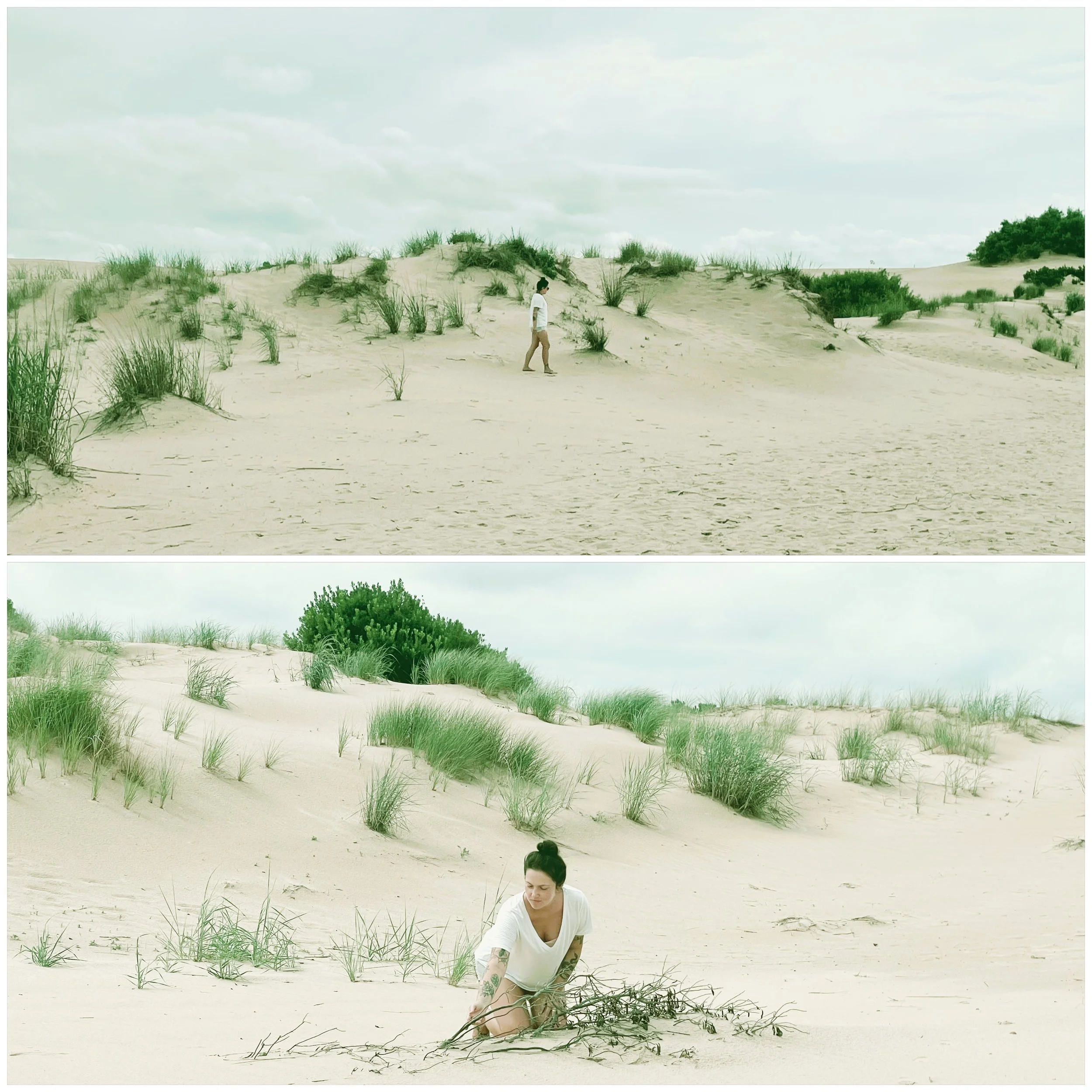
Manifesting without Attachment
Another way of putting it is that to avoid our intentions coalescing around hardwired patterns from our past, we need to move towards deeper layers of the unconscious. In the aspects of our core self that predate all that conditioning and experience we find our true potential, all those individual aspects that could manifest into endless variations of future selves. Focusing attention here allows for manifesting to be more about returning to our most innate capacities and purpose, the unique qualities and potential that we cultivate into a more meaningful life that benefits those around us and ourselves.
I wrote several different possible introductions and titles for this essay, I’m still not entirely settled that I’ve found a succinct way to say it. Because maybe I’m not really talking about “manifesting” at all, but more of an alternative to the concept. In my experience it is clear that to a certain extent, manifesting is absolutely possible. “To a certain extent” has a big asterisk, largely relating to actual material limitations that apply to everyone and especially to those with identities historically made marginal. If I were still on Instagram I would try to link to the first time I saw someone write “is it manifesting or is it white privilege?” This is the issue I take with The Secret or even those who speak of financial difficulties arising primarily from energetic blocks. Sometimes that’s true and sometimes it’s not.
But there’s another aspect of manifesting or “positive thinking” that I would like to challenge. Much of the premise behind this concept is using our conscious awareness, thoughts, and behaviors to support the development of desired outcomes. Our conscious desires and beliefs are often underwritten by unconscious emotions, wounds, traumas, and societal programming that define what we think constitutes a good life or success. Milton Erickson, founder of Ericksonian hypnosis famously said “your conscious mind is very intelligent, but your unconscious is a lot smarter.” I interpret that in two ways: sometimes our unconscious holds more meaningful answers and resources than our conscious mind, and also our unconscious is often running the show outside of our awareness and in spite of our intentions. It begs the question, how do we know that we’re manifesting what we actually need, rather than what we think we want?
Last summer, after quite a lot of successful manifesting intention work in the more traditional sense over the last 5 years, I found myself exploring a different approach. This was a natural extension of my psychic development, which frequently demonstrated in myself and others that our capacity to dream is often limited by our conscious beliefs of what is possible. It’s also shaped by what we believe others expect of us. So I started focusing more on living an intuitively driven life through clarifying my ability to see and feel things clearly. And my goal was centered on staying connected to inner and energetic resources that would support making the next right choice. Instead of seeing what I wanted and trying to bring it to fruition, I worked with the more abstract intuitions of which direction to move, and how to be in the best mental and physical condition to respond with curious awareness.
This started to change my life quite dramatically, and I did notice at the time but it’s especially noticeable reflecting back. Some of the new opportunities, fortunate developments, and not so pleasant clearings of problematic situations and people in my life were completely unexpected and beyond anything I could have imagined. If I had limited my focus to “manifesting” what I thought I needed at the time, it would’ve been so much harder. It would have been much more a continuation of what was already happening instead of a clear pivot. Because that’s a big part of my unconscious belief system, that good things need to be hard. That my life needed to be hard to be valuable. Instead, things evolved and transformed what I could only describe as divine timing.
Another way of putting it is that to avoid our intentions coalescing around hardwired patterns from our past, we need to move towards deeper layers of the unconscious. In the aspects of our core self that predate all that conditioning and experience we find our true potential, all those individual aspects that could manifest into endless variations of future selves. Focusing attention here allows for manifesting to be more about returning to our most innate capacities and purpose, the unique qualities and potential that we cultivate into a more meaningful life that benefits those around us and ourselves.
I’d like present a technique for drilling down into the core, unconscious needs:
Begin with what you think you want or need. Think about what you would like to change, or wish was different.
Now ask yourself how you imagine you would feel if that were true, what are the emotional roots of that desire?
What are the core needs that define those feelings? For example, if you desire romantic companionship, the core needs could be feeling loved, connected, supported and cared for.
Then reorient your desire towards those core needs. Instead of “I want to meet a romantic partner” you might affirm “I want to feel loved and connected, I want to feel partnership and intimacy, I’m open to anything that might satisfy those needs.”
And then taking it a step deeper would be to acknowledge that some obstacles are unavoidable- there can be learning involved in difficult times or times of loneliness- but also it’s the nature of life that we have ups and downs and sometimes we experience bad luck with no secret meaning. (“Pain is not a punishment and pleasure is not a reward”)
Connect to some acceptance that perhaps there’s nothing you’re doing wrong in this moment and if so, then so it is. Indeed, feeling different can sometimes come even without material changes.
Consider the action that would support that feeling developing, focus on those behaviors as your collaboration with your intuition.
Frequently we arrive at a few core themes underlying our desires: safety, security, love, satisfaction or purpose, pleasure, and connection (of course there are more). And when we focus on supporting these things into fruition, we open the possibility to dream bigger. Maybe you can even imagine or visualize if there could be other ways you could arrive with the same feelings, other ways you could feel satisfied. Sometimes just this slight opening of willingness can help us to see where we jump to preconditioned ideas of what we need or what will make us happy, when actually there are many more routes to get there. Or even ways that we already have more than we thought.
How can you be more open to imagining futures beyond your current awareness?
What would that look like feel like?
Can you give yourself permission to dream?

Breathwork is Trancework is…
This letting go is a gateway into deep realms of knowledge, but our bodies often stiffen against it and our minds become fearful. In psychedelic experience we might describe this as the dissolving of the ego, and in hypnosis the shift into deep trance is often reported as a feeling of “falling” into or through something.
One of my primary goals in scaling back the number of hours I “work” has been to create the space necessary to read and learn more, time to reflect, and time for embodied practice. Lately there has been a lot of synchronicity in what I’ve been reading and seeing, mirrored by my embodied experiences. The initial thoughts for this piece began last spring while I was listening to an episode of Getting Curious with Jonathan Van Ness where the guest, Professor Beronda Montgomery, was speaking to the genetic connection between humans and the surrounding trees (in a beautiful story of ancestral connection she shared while reluctantly visiting a plantation site with her children), and it added a deep layer of reverence in my Breathwork practice to think about this reciprocal relationship with my nearby plants. I had been sitting with that for a while until this past week when I was watching several presentations in the Breathwork Summit. In a session on Breathwork and the quantum field with Dan Seigel, he shared his own process of shifting between searching for answers as to why we experience a sense of universal connection/god/oneness during Breathwork practice in the brain to looking for it in the concept of energy, and that leading him to quantum physics. He described it beautifully when he said “energy is the movement from possibility to actuality.”
I don’t think the shift from science to mysticism is unusual at all, I read it all the time in various writing of folks doing healing work who came from a more skeptical or “evidence-based” background. I can relate to it personally too. Honestly the first part of his presentation was a bit hard to watch, as he is trying desperately to frame in objective, quantifiable terms this phenomena of how the mind can shape one’s reality- and especially justifying the science behind oneness.
The need to frame this work in a Eurocentric lens rooted in the “scientific method,” focused on individual integration as the norm for health, tremendously limits the potential for grasping the expansiveness of these deeper levels of consciousness. Because there are so many paths that lead to this mind-space. And the more creative we can be in finding our way there, the more routes we develop, the easier it is to drop into whenever we wish. In another session Dr. Angel Acosta pointed out that interconnectiveness coexists with the specificity of personal identity and experience (he was speaking to racial and cultural identities in particular), and that especially for folks of privilege it is important to intentionally hold those realities simultaneously- which he described as “critical humility.” Oneness doesn’t mean we all have the same experience, perspective, advantages, or even that we share the same “reality.” When we connect to oneness we can hold that there are many realities side-by-side, some intersect and some do not. Embodied knowledge helps us hold these truths simultaneously.
In my own experiences with altered states of consciousness that were not induced by a substance, it’s actually key to be able to move between states of awareness rather than having them all integrated, because interacting with the physical world often involves filtering information. As much as I love being able to shift my dimension of presence and (for example) see little waves and threads of energy between the leaves of a tree, that is not helpful when I’m trying to order a sandwich or do my taxes. Also, if I can only get there after 45 minutes of meditation, during a massage, or in a beautiful physical environment then I’m not actually living in that interconnectivity on an ongoing basis. The ability to shift allows us to primary be in that expansive quantum space, but also shift into “3D” to do things we need to do. Similarly, it allows us to hold multiple realities of the beauty and the pain of the human experience. Over time it becomes as straightforward as shifting our visual focus from something we’re reading up close to a street sign in the distance.
In The Disordered Cosmos (a great interview with the author can be found here), the author states that the universe is queer, and cosmology is storytelling. Which is to say that science is not separate from social and relational contexts, and it’s more expansive than it sometimes appears. And I think in that sense trance could be described as quantum field work, and in that space we can hold the stories, the oneness, individual paths and collective ones together even as they may be in tension or contradiction with each other. Getting into deep trance on your own can be challenging, unless you use the breath. The breath is the foundation for all the other work: you can’t practice meditation, do energy work, or drop into the somatic body without breath awareness. While this can lead us to the transitional space of consciousness, a challenge emerges in the “letting go.”
This letting go is a gateway into deep realms of knowledge, but our bodies often stiffen against it and our minds become fearful. In psychedelic experience we might describe this as the dissolving of the ego, and in hypnosis the shift into deep trance is often reported as a feeling of “falling” into or through something. Sometimes we need to use the breath a bit more aggressively to get this effect, such as Multi-part Fast-paced Breathwork, but again in time we can do this with our focus, leading with the mind-body and letting the somatic body follow. In Multi-part Fast-paced Breathwork the sensations of the body can become overwhelming and seemingly independent of the physical body, and also stuck in the physical body. This phenomena might describe the common experience of having strong physical tension in the hands (the well-known “lobster claw”), accompanied by fear, often managed well by squeezing or holding stones/crystals in the palms, breathing into the heart space and tracking the accompanying emotions. Often there is emotional movement that begins to eclipse the physical sensation and incredibly the physical sensation resolves OR continues but ceases to matter. We can feel the parallels and paradox of the physical and energetic systems. Both are present, we are deeply embodied while also experiencing expansive consciousness beyond physical form- beyond this lifetime even.
The concept of Dark Matter (I’m paraphrasing here!) refers in part to the unknown, unseeable aspects of the universe that help explain aspects of quantum physics that don’t make sense otherwise. In the books and popular HBO series His Dark Materials, after traveling to the dimension that resembles our world Lyra shows a particle physicist that is possible to commune directly with dark matter/“dust”, and in turn the physicist uses the I Ching to learn that this force is actually angels. Meanwhile in the tragically cancelled series The OA (slight spoiler here so skip to next paragraph if you don’t want it!) the ability to move between dimensions is achieved by a series of movements enacted in “perfect” emotion by at least five people (a pentagram) and also had a tie-in with “angels,” time travel, and multiple selves/versions existing simultaneously.
So what’s my point in telling you my TV habits? What does this have to do with Breathwork? I guess contemplating this curious synchronicity between “fact and fiction.” It’s not surprising that there are many common themes among the best works of science fiction because they are frequently responsive to the most mind-bending ideas in quantum physics, among other things. I often remark in reiki groups and with students that the more you practice the more it feels like science fiction. I wonder about some of the more spiritual similarities that are easily observed in trance and ritual experience, as well as centuries of indigenous wisdom, and if the realm of fiction just presents a way of folks sharing that experience without sounding “crazy.” There’s some affirming about knowing that other people are trying to imagine what this really looks like, illustrated with rich allegory and the complexity of human relationships. Maybe that’s an obvious thing to say, and yet we often draw a hard line culturally between what is known and unknown, and see fantasy as a genre that fosters escapism. But perhaps it’s also a connection- in a form that is more predictable and safe.
I’ve always enjoyed some good fantasy media but if I’m honest my interest in it grew in tandem with trancework exactly because it captures much more effectively the elusive questions that emerge. It’s not easy to discuss questions about the nature of the universe these days, especially when the impacts of denialism and anti-science sentiment are so ever present and dangerous. I don’t see mysticism and science as being in conflict necessarily, more the people who hold unshakable views as being in conflict. Some healthy skepticism is important in talking about spiritual matters, just as curiosity about the unknown is necessary in the realm of science.
All this being said, Breathwork doesn’t need to be as intense spiritually as I’m describing! It works equally well within the tangible matter of our lives and relationships. And it’s beautiful even in it embodied practice with no meaning or questions applied to it at all.
Personally I choose to take an active approach to Breathwork practice because I find it enjoyable. Working actively creates a renewable resource and charts new pathways of understanding. In self-hypnosis we often choose a destination, which is then the “beginning” of the trance and I use this concept in Breathwork. Often I will start with a childhood memory I rediscovered in trancework, I wait in this place for any “guests” to join me (past selves, animals, other energies), and then travel through my memory of the woods behind my childhood home to a house I constructed in my mind where all is possible. (Some of you have heard me speak about this concept of “a home within.”)
I allow myself to engage in a lucid way in this space, sometimes receiving messages or interacting with a future self, other times I have an agenda and do a healing session or ritual with myself while I’m there. I allow my physical experience to inform the trancework as well.
Sometimes I revisit a dream that needs resolution, working it through to a new end. Other times I visualize into the future, asking for vision to see clearly what is possible. Or I send support to myself at a future time, or receive support from that future self. I let that carry into the rest period of breathwork practice.
There are endless ways to approach it, these being just a few that I’ve done often.
If you’re in a process of harnessing the breath to shift your consciousness, where do you want to go?
What are the burning questions, the points of confusion or tension that call out to you?
Where does the sense of oneness arrive, and what will you do with it?
Rest is a Portal
There’s no aspect of a cycle that doesn’t require a time of apparent dormancy. And yet that dormancy is often an illusion; it’s no so much that there is no movement or change as it is an unseen process. Eurocentric or “western” culture doesn’t value the unseen process very highly. The capitalistic culture doesn’t even believe in the value of that which cannot be measured. When we want to notice the process inside, the subtleness of our “going on being,” we often begin by closing our eyes. And when we do that we shift our focus away from moving our bodies physically in space and seeing in the external sense.
Resting creates the necessary slowing down to create deeper shifts from a safe location. And frankly we don’t always exit a portal feeling great. Sometimes rest only highlights what needs to change, or ways that we need more of something.
What can appear inactive to others might be full of life and growth internally, and conversely what may appear active in the eyes of others may feel quite slow to the subject. The later is often my experience as we approach the turning of the year. On the outside I feel quite active, I’m often dreaming and planning for the next year, taking stock or what has changed already and what needs to change. Reflecting and integrating, putting out new offerings and calling in greater connection. But internally I am slow. Witnessing without changing (yet), surveying the landscape and settling into unknown and void spaces, asking questions and not finding as many answers.
It has been a delight for me to see so many people en mass start to seriously challenge whether to seek all their satisfaction from work. To consider that maybe there’s something more, that while in practice we may be in harm reduction mode in our relationship with money we can still dream of a life more full and connected.
In the era of “if millennials would just stop buying avocado toast they could own a house” it was surprising for me to discover this past summer how much lacking enough time translates directly to spending money and overall attachment to material things. And how that actually manifests across income (understanding of course that when in more dire straits our choices become more limited). This isn’t about blaming yourself for financial difficulty and fatigue, it’s about acknowledging that there is a vicious cycle between need, want, and urgency. Time is of great value, time is related to rest, and when we don’t have enough time we seek quick solutions to feeling connected and cared for. There were some beautiful and synchronistically aligned thought pieces this year that clearly show this is not just a personal shift but a collective one. But it actually took a while of having enough time for some of my own habits to change.
This summer I enacted a radical seasonal change that I had tried unsuccessfully to implement for three years in a row. The dream was simple: I wanted to make it to a city beach at least once a week for the entire summer and swim in the ocean for at least 30 minutes without having to get up before 8am (I work late folks, don’t judge me!). The thing about natural environments is that they run on their own schedule. Not every day is suitable for swimming in the ocean comfortably, and so you need to have multiple days available. It’s also not a 24 hour thing (for me at least), there’s a limited window of time in the day to be at the beach. Then there’s the matter of rinsing off and getting dry again, eating something, and getting dressed for work on weekdays. The main factor here was that there needed to be a chunk of time available that could accommodate all of that, plus getting there and back. As folks naturally flowed through my practice I had to start taking away available hours a couple months in advance so that I started later every day to make this possible. On the surface this would appear to be a poor financial choice, cutting 4-5 appointments each week for several months. But something totally unexpected happened: the net change was almost (not quite) zero. How could this be possible?? The answer was pretty simple, I was grounded and happy and felt connected…and I didn’t really crave the things I used to. I didn’t mind throwing together inexpensive meals because I had plenty of time. I felt fit, my skin was clear and healthy, and I didn’t care so much about new clothes and such. I was tired from a full morning most days and my “entertainment” was largely being outside. My spending dropped almost inexplicably, and I realized just how much I used money to solve the problem of “satisfaction.”
This may not be a relatable example for you but there’s a version of it that is. One where we try to buy time when we really need space to rest. I’m sure for each of you there is something that you love that doesn’t really cost anything but time… A practice that bends time for you, offers you more in return than it actually took. This feels even clearer as I’ve become only slightly busier and I feel the presence of the old habits creep in. I’ve found that I need a lot more time than I think I “should” to actually rest. And to get that time I need to unplug even more from capitalism, because that’s the math. This also means redefining what success looks like to center the experience rather than how an observable measurement. Assessing value and currency beyond cash: time, relationships, physical health, contentment, connection, and the ability to make choices.
Maybe you’re feeling it too.
Here are some prompts for further exploration:
Are there certain times of year where you feel called to rest?
What does rest look and feel like for you?
What changes in your life when you are truly rested?
What fills your cup?
How does your work life correspond with your rest/personal life?
What are the areas of value in your life, how would you define success beyond metrics of career, money, or prestige?
What are your personal indicators that you are off balance?
What could you change this week to show yourself that you’re committed to restoring your sense of balance?
What is Dreaming, Why Dream?
The last few months I’ve been dreaming very vividly, intensely, most nights and resulting in more than a few nights of little rest. As I said, increasing the only way to work with those dreams seems to be during them- I find myself waking up with both a deep understanding of something complex and important for me personally and also unable to describe it beyond some fragments. They are so abstract I can’t really tell the story. Dream references keep appearing in strange synchronicities too, which creates this bridge between night and day dreaming.
Although in some ways the content of this particular essay has been percolating for the last couple months, I have really struggled to put it into words and sentences and paragraphs that lead to a Point. You’ll have to forgive me for the somewhat non-linear nature of what I’d like to share. And after all, how could reflections of dreams and dreaming be anything but a spiral of ideas leading everywhere and nowhere?
I’ve always been a prolific dreamer, since I was a child. Dreaming at night, as well as daydreaming. I’m not saying my dreams are all deep and profound, but they are plentiful, I usually remember them, and they have been mostly lucid since my early 20s. One of the most common dinner party questions posed to me as a therapist is something along the lines of “So are dreams even important? Or are they just random information?” Invariably such a question is almost always followed by “I had a strange dream, I’m sure it would be so boring to tell you about it…” and a reference to a well known quote “Nothing is as boring as other people’s dreams.” I wholeheartedly disagree, anytime someone has a dream my first instinct is to ask what it was- much to the boredom of many within earshot.
Certainly there has been research that shows that much of our dream content is as mashup of recent images and experiences; in studies attempting to test this researchers would expose dreamers- ahem– research subjects, to images in a lab setting and then ask what they dreamt that night. This is often used as evidence that dreams don’t really have meaning, that it’s just random information, because generally the images shown would appear in the dream content and scenery. But truly there is no way to measure meaning. And perhaps more importantly this is strongly supportive of a common belief among dream analysts and those who practice dreamwork, which is that the images and even scenarios of the dream are symbolic. And they’re symbolic not only of deeper representations (which would more accurately be described as metaphor) but also that they contain multitudes of information at once.
The person in your dream can be both representative of the person you know them to be, as well as similar figures, aspects of their personality, who they are in your life now, or a feeling you also had towards another person.
This is that strange quality where someone might say, “I saw my friend was in the room, but I somehow knew that actually they were my uncle.” Or the way that we can have or existing information about something that happened prior to the dream’s timeframe.
I’m most partial to the Gestalt style of dreamwork which creates a lot of space for the dream’s metaphors to be explored from the perspective of the dreamer, as well as other elements of the dream. It seems to hold the most flexibility for the ways that we have personal symbology that is unique to the individual (though Jungian dream analysis in its use of archetypes is certainly quite interesting). I’ve seen great resolution and insight occur from facilitating this type of dreamwork over the years. And I have experienced it personally as well.
But even this still focuses on deciphering the “meaning” of dreams in a linear sense. I think that in a way this flattens the true nature of dreams. More and more I believe that dreamwork must take place in the actual dream space to work with the fullness of what it represents. And that we can only really understand dreams while dreaming. This is the way that I practice dreamwork personally for the last few years, which is aided by developing the skill of lucid dreaming so you can be more aware in the dream state. There are so many interesting films and books that speak to ways we can be curious about these levels of dream consciousness. Waking Life comes to mind, as well as several by Ingmar Bergman.
In Baba Ram Dass’ well-known book Be Here Now he says:
“Actually, what we refer to as “dreams” are merely experiences we are having on planes other than the physical plane. Such experiences are going on all the time but usually our awareness is attached to the physical plane and we are oblivious to any other information coming from these other planes.”
I recently encountered a short film, Pumzi by Wanuri Kahiu, set in a dystopian future where survivors of World War 3 are required to take Dream Suppressants that, among other important reflections, highlights the power of dreams to upset the status quo and lead to greater freedom (at least of mind).
The last few months I’ve been dreaming very vividly, intensely, most nights and resulting in more than a few nights of little rest. As I said, increasing the only way to work with those dreams seems to be during them- I find myself waking up with both a deep understanding of something complex and important for me personally and also unable to describe it beyond some fragments. They are so abstract I can’t really tell the story. Dream references keep appearing in strange synchronicities too, which creates this bridge between night and day dreaming.
I began reading a book that was recommended to me many months ago by a friend, Buddha in Redface, which has been sitting on my shelf untouched since October. I didn’t really remember what it was about when I started and it hooked me on the first page of the introduction where it reads:
“There has always been a dream. Everything is still the dream. All that we call creation and Creator is the dream. The dream continues to dream us and to dream itself. Before anyone or anything was, there was a dream, and this dream continued to dream itself until the chaos within the dream became aware of itself.
Once the awareness knew that it was, there was a perspective for other aspects of the dream to comprehend itself. One of the emerging dream energies, or ‘complexes,’ that came from the chaos of the dream and still remains in the dream as a way for the dream to recognize itself, is called ‘human beings.’ Human beings required a way to have perspective and reference, and because of that, another energy emerged from the dream, and this is known today as `time.’ It is from the two energies of dream and time that the third was given birth to, and that third one is known as the dreamtime.’ Dreamtime is also known as ‘mind,’ which is by nature luminescent and pure. And the dreamtime mind is reflected by the emptiness of awareness.”
Dreams are so deeply linked with imagination, more often than not when we refer to our Dreams we are actually referencing things we wish to manifest and achieve in our lives rather than our nighttime dream states. Similarly, often in Western culture we degrade the process of dreaming as something less intelligent or rational, with sayings like “she has her head in the clouds” or “that’s just a pipe dream” (which is a originally a reference to the thought processes of those smoking Opium and generally means something impossible). And yet we rely heavily on dreamers for much of our progress and forward movement, and systems of power and oppression rely heavily on our ability to suppress and repress our dreams. I’m sure you can think of endless examples of great visionary thinkers and activists whose ability to dream literally opened up new worlds to us.
Much like in dreams I’m finding there is no end or conclusion to this short essay, other than perhaps to say that I’m making a commitment to dreaming in a serious way. And offering an invitation for you to consider what could change if you took your own dreams more seriously- the waking ones and those while you sleep.
Reclaiming self-worth: Integrating your inner child(ren)
Trigger warning: discussion of abuse culture, and brief reference to the documentary Allan vs Farrow
Culturally we are reckoning with abuse culture in a way that has never been so sustained and is moving across demographics that were not previously engaged with anti-violence activism. The push for accountability is needed and long overdue, and yet the focus on punishment seems to be bringing the focus on conversation to the abuser rather than really reimagining what justice and healing might be for those who have experienced abuse.
There are a lot of complexities that live within the realms of survival and recovery, some in opposition and creating confusing and harmful binaries.
The public backlash against abusers, though often warranted and needed, ignores the underlying and foundations causes that our society more broadly needs to be accountable for. Namely, the ways that we are socialized to see some people as more human and deserving of respect than others.
One of the things I found most distressing and affecting about Allen vs Farrow is the way that Dylan spoke about her inner child. To be honest I don’t think we hear enough about the role of younger selves in ongoing recovery outside of spiritual healing circles and sometimes trauma therapy if it includes Internal Family Systems. Often times the younger selves who experienced abuse are still very fearful and in need of protection well into adulthood, and we can be aware of those parts quite viscerally when encountering similar personalities and behaviors to abuse we’ve experienced. And there is an added layer of complexity to sometimes having a sense of real love and connection to those who have harmed us, especially when this occurs in families, leading to confusion about what needs protecting and how to navigate fear.
More broadly when we refer to the inner child there can be an assumption that there’s only one, or that the age when we experienced some sort of trauma is the only younger self that needs healing, the only one worth acknowledging. But there are so many versions of ourselves unfolding all the time and there is a “before” and (hopefully) “after” of those events as well. We often develop our psychic protectors of the “inner child” when we are still children. It’s not one dimensional, and we may relate differently to these parts and some parts we try to forget all together.
There are the inner children who existed before devastating trauma, or at a certain stage of trauma where there is still spontaneity, imagination, and willingness to trust. There are those who found a place to secure themselves while terrible experiences unfolded, who were able to bend the continuum of space and time to hold on to themselves even as the circumstances could have crushed them. There are those who emerged in the aftermath or continuation, often re-emerging many times to create more effective modes of protection and stability.
When the focus becomes about the age/time/experience of abuse or traumatic experience we are still flattening the wholeness of self into that of the victim/survivor. It is still a focus in some ways on the abuser, letting an experience caused by another be the defining characteristic of self.
I think about trauma healing a lot, because like many people who do this work my own life depends on it. I do think there’s benefit to the idea that it’s a process, that it’s chronic and spiralic, that there’s no “end” to reach. And yet I can’t help but feel like this can become a way of perpetuating the idea that one is fundamentally broken and will never be repaired. One way of making a start on integration that goes beyond coping is working with inner children not only who need our protection, but who actually hold keys to wisdom, healing, resilience, and creativity that we as adults have forgotten. Much in the same way that we can work to access future selves as a way to move through difficulties in the present, we can look to younger selves as guides for our innate potential and find our inner healer rather than seeking that relief from outside.
When we can do that within community or in the presence of others we access the balance of needing others while finding resources within ourselves. Below am I sharing some journaling prompts from a group I’m holding to facilitate cultivating self-worth through a rediscovery of our innate worth and allowing those parts to become guides for our future healing. It is about remembering that we began with an inherent knowledge of our worth and value, we began embodied, and we began fully believing that we deserve love and care.
Exploring your own Inner children
When you think of the term “inner child” what comes to mind? What age, and what associations?
What is an age or era of yourself that you have neutral to warm feelings towards? What did they know, what were their qualities?
What do you think were some of the experiences of your childhood that have shaped who you are now (both positive and negative)?
Are there times you can remember where there was a shift within the way you navigated the world as a child, when your perspective and approach to relationships changed (a new “self” emerged)?
What happens when a shift occurs, where does the previous mode of being go?
Are there some versions of yourself that you really like, or that have qualities that you miss from an earlier time?
What about parts of yourself you struggle to accept, when did that emerge?
What could be different about your life if younger parts that need healing could receive it, and younger parts who hold wisdom could be invited back into conscious presence?
How would your relationships and sense of yourself change?