my approach
Tantric Meditation and Yoga Nidra
Most people come to meditation because they wish to feel steadier, more calm, and free from worry. In the yogic tradition this aim is described as Chitta Vritti Nirodaha: stilling the fluctuations of the mind.
The mind is a powerful force, continually generating thoughts and holding tremendous sway over our emotions and behavior. However, the mind space and its thoughts are distinct. When we can harness the power of the mind, remaining an observer of thoughts and emotions, they lose their sway and a deep steadiness develops within.
My classes present modern and classical techniques that are safe and suitable for beginners. Read on to learn more about Tantric Meditation and Yoga Nidra.
All Meditation and Yoga Nidra classes are donation-based: a small donation is required to register, to honor the time and energy of developing the classes. If this donation amount is beyond your reach, you are welcome to email me and I will send you a code to register for free.
What is Tantra?
Tantra is an ancient, world-affirming, and comprehensive spiritual philosophy that offers meditative techniques for realization and liberation, and is practiced in both Buddhism and Hinduism. The classes I teach are rooted in the Yogic perspective, and informed by the traditions of Sri Vidya, Kriya Tantra Yoga, Kaula Marg Tantra and Shaivism.
Words cannot capture the full depth of Tantra, and invariably this description will fall short. However I hope it can serve as a general introduction, and I offer this with reverence and acknowledgement of the Rishis, Gurus and Satgurus who have kept these traditions alive and available for our benefit.
The Tantric perspective is non-dual: the world we see appears to be one of opposites, yet all are One. In Tantra, the divine is believed to be present in everyone and everything, even that which appears to be destructive or seems to be in duality. It is considered that one of the great illusions of human experience is that we believe we are separate and need to find connection or restore goodness, and Tantra tells us that by returning to our deepest sense of Self (our True Nature), distinct from personality and experience, we find that we are already a part of that wholeness that we seek.
This is not achieved by simply ignoring what is unjust, or never having “negative emotions.” Rather, the practices work through patterns of thought and action rooted in the subtle body (energy body), allowing them to be expressed in more refined ways. We also practice cultivating elevated attitudes and wisdom in meditation, which over time influence our day to day actions. In Tantra we repeatedly guide our awareness back to the position of an observer of our own consciousness— accepting all of it, both positive and negative— and develop the ability to respond more wisely rather than react. Further illustrating the nondual perspective: we both pursue right action AND cultivate the ability to accept things as they are.
One of the central aims of Tantric practice is the awakening of Kundalini Shakti, the creative force of Prana which rises from the base of the spine. Through mantra, pranayama, meditation, and dedicated practice, the subtle body is tuned and progressively cleared of obstacles, allowing this force which often lies dormant to become accessible. While Western approaches to Tantra often emphasize practices from some lineages related to sacred sexuality, its true purpose is self-realization.

What is Tantric Meditation?
Tantric meditation is comprised of techniques that work with the subtle body to still the fluctuations of the mind and allow us to access inner knowing, and eventually experience the state of Samadhi, enlightenment.
Tantric techniques offered from this tradition generally include:
Pranayama
Breath Awareness
Dharana (concentration)
Visualization and Kriya techniques
Mantra
Mudra (hand gestures)
And observation of Chittakash (the mindspace).
In some ways Tantric practice is like a pantry that can create variations on different recipes: there are ingredients that are foundational and present in almost every dish, and others that offer a unique flavor. Many Tantric practices are deceptively simple— they are subtle and the deeper wisdom within these practices becomes available through dedicated and consistent practice. Other practices are more complex and require concentration, Dharana, and so here we have the balance! There is a science to Tantra, wherein certain practices are combined and produce reliable results. Over time we develop familiarity with our own subtle system, and in self-guided meditations, we can choose practices on a day to day basis that will support us on the path to liberation.
I offer an ongoing meditation class Shakti Rising with open enrollment on a monthly basis, and each month works with a theme so that specific practices can be developed over time and one can understand the effects of those practices on their own system. Classes are offered live with replay, and you are also welcome to participate by recording.
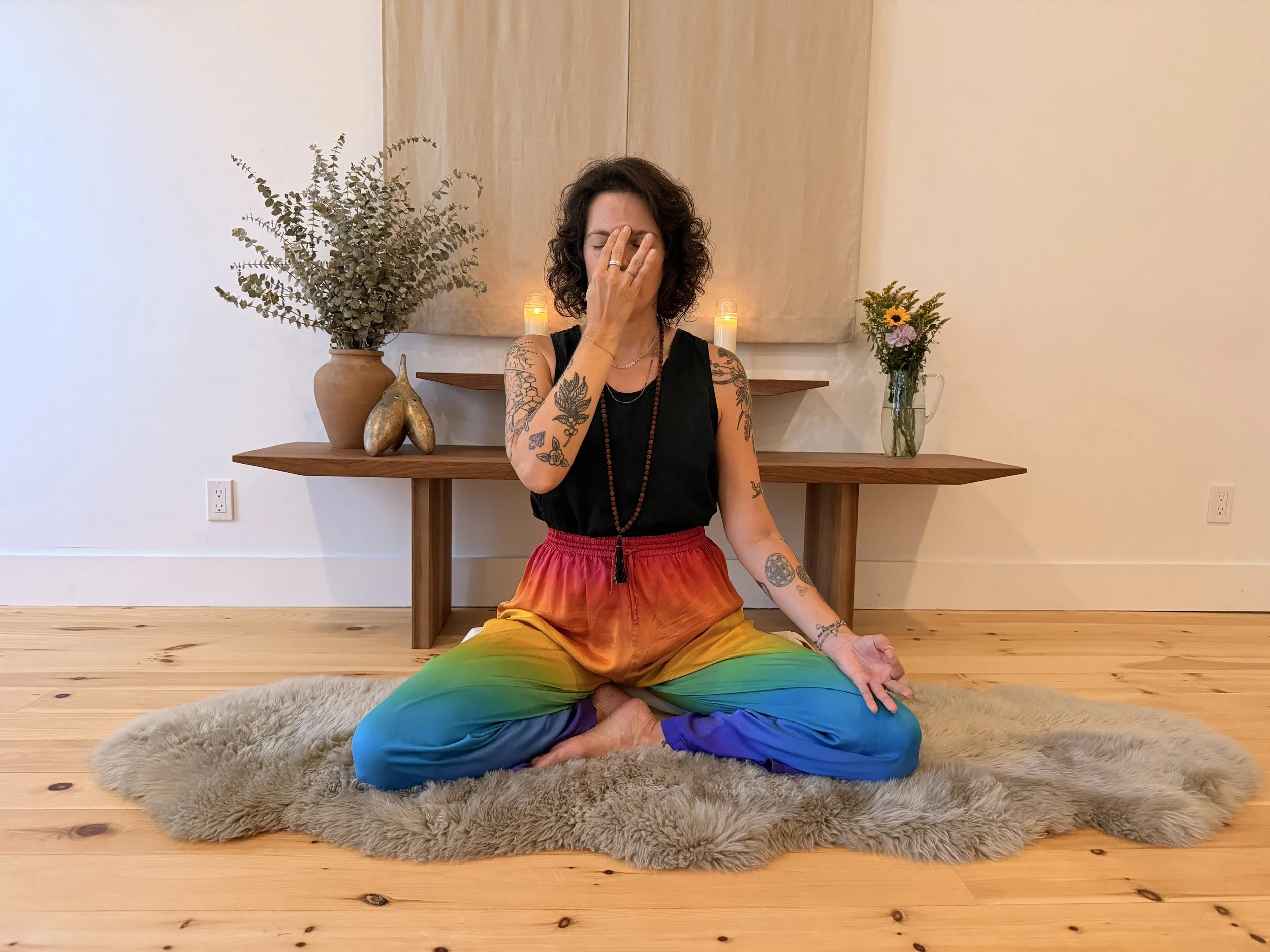
Want to try a practice first?
The video below is a morning movement and meditation practice, incorporating some gentle movement to release tension in the spine and hips. If it’s not suitable for you to sit on the floor, you can also sit in a chair.
After the movement practice, you’ll be guided through a short meditation incorporating the practice of Sama Vritti and the So’ham Mantra (Meditation begins at 17:50 if you’d like to skip ahead)
What is Yoga Nidra?
Yoga Nidra is a meditative technique, practiced lying down in Savasana. It is a relatively modern practice, developed in the 1950s and informed by the psychological theories of the era along with modifications of yogic techniques. Over the years a number of different styles of Yoga Nidra have been developed, each offering somewhat different approaches, but all create the conditions for moving your awareness through layers of the being, and relaxing the mind, body, and spirit.
Often described as a rest practice, Yoga Nidra is translated as “Yogic Sleep. ” This means the the body moves towards a deeply relaxed, sleep-like state while awareness remains awake. The wisdom of deeper layers of consciousness can be perceieved while the mind is relaxed, offering much therapeutic potential.
In the Classical style, these techniques retain their roots in ancient Tantra but have been adapted to be suitable as a standalone practice for all levels of experience and do not require any specialized knowledge. Yoga Nidra is practiced entirely lying down, with no movement involved.
I teach Classical Yoga Nidra, which means that practice moves systematically through eight stages: settling the body and establishing an intention (called a Sankalpa), awareness of outside sounds, rotating awareness around the physical body, breath awareness, cultivating opposite feelings and sensations, visualizing symbols, a guided journey or other visualization, and observing Chittakash (the mindspace) and then returning to an alert state.
I offer virtual Community Yoga Nidra twice a month, on Sunday at 4pm ET and Thursday at 6pm ET, and sometimes offer longer workshops which include other practices.
Individual Guided Meditation & Personalized Yoga Nidra
Individual sessions can be useful for the beginner in meditation and for the seasoned practitioner. Meditation can be uncomfortable. Occasional sessions provide a space to ask questions, clarify foundational concepts, and receive suggestions; for many this can provide support to ground practices in a holistic perspective.
For those who seek meditation due to more persistent anxiety, trauma response, or chronic pain, it can sometimes be difficult to find ease in the practices early on. Personalized meditation guidance offers the chance to make adjustments that allow practices to be more accessible, and so that capacity can be developed in stages. It also offers space to discuss emotions, memories, sensations, and thoughts that can emerge in practice. While these are not therapy sessions, my background as a psychotherapist provides unique insight into modifying techniques and offering support for those on a spiritual path. Personalized Yoga Nidra can also be an excellent alternative or compliment to seated meditation, offering greater emphasis on rest and the most easeful of the physical meditation postures (laying down). Sessions can be scheduled as needed, or at regular intervals for a period of time.
I personally have found the ongoing relationship with my teacher to be an invaluable resource for the inevitable challenges that may arise in Sadhana, and it is a great privilege to assist others who may benefit from added support.
Individual sessions can be booked online through the link below, and some sliding scale is available using the code in description.